
 by Usman Sheikh
506(b) vs 506(c): Can You Advertise Your Next Raise?
Published · By Usman Sheikh, CPA turned marketer
This choice usually gets made in one meeting with your lawyer. It decides how you can find investors for the whole raise.
By the time you sit down for that meeting, a lot is already moving. The building is under contract. The lender wants to see the equity. A few of the people who backed your last deal have heard about this one and told you they’re in.
If you choose 506(c), our 506(c) marketing agency page shows how we run investor acquisition for sponsors.
Then counsel asks whether you plan to talk about this deal in public. It sounds like a paperwork question. If the people who already know you can fill the raise, the quiet route is usually fine. If the building is bigger than your circle, you’ll need people who have never met you, and that changes how the whole raise runs.
Rule 506(b) and Rule 506(c) are the two paths most US real estate sponsors take. This guide looks at them the way a marketer would: what each one lets you say about your raise, where you can say it, and what the work of finding investors looks like under each, so you can walk into that meeting knowing what you want.
The real difference is what you can say in public
Under 506(b), you cannot advertise the offering or invite the public to it. No ads about the deal, no public posts about the raise, no open webinar where strangers hear the terms. The deal travels from you to people you already know, one conversation at a time.
Under 506(c), you can talk about the deal anywhere. LinkedIn, Google and Meta ads, a public deal page, a podcast interview, an open webinar. The trade is that every person who invests has to be an accredited investor, and you have to take reasonable steps to check that they are.
So the marketing question is simple: do you need to reach people who don’t know you yet? The table shows how that plays out channel by channel.
Where you can talk about your raise under each rule
A marketer’s starting point, based on SEC guidance. Take it to your securities counsel before anything goes live.
| Channel | 506(b) | 506(c) |
|---|---|---|
| Email or a call to past investors and people you know well | Yes | Yes |
| Introductions from your current investors | Yes, but get to know the person before you share a deal | Yes |
| Public posts about your company, market and approach, with no offer | Generally yes; ask counsel where the line sits | Yes |
| Public posts about the specific deal you are raising for | No | Yes |
| Paid ads on LinkedIn, Google or Meta for the deal | No | Yes |
| A public landing page with the deal’s terms | No; keep offering details private | Yes |
| An open webinar or podcast about the deal | No | Yes |
| Who can invest at the end | Mostly accredited investors you have a relationship with | Accredited investors only, each one checked |
Under 506(b), your marketing runs on relationships
The relationship has to come first. The SEC’s own page on 506(b) notes that the more remote an investor’s relationship with the company and its management, the harder it is to rely on the rule. In marketing terms, you build the relationship between deals, and you bring the deal to people once you know them.
You can still be visible. SEC staff have said, as a 2015 Skadden alert summarizes, that the advertising ban does not stop a company from sharing factual information about its business in public, as long as it is not presented as an offer. Projections and opinions about what an investment is worth fall outside that. So a 506(b) sponsor can still write about their market, show finished renovations, and explain how they pick buildings. What they leave out is the raise itself.
In practice, 506(b) marketing looks like this:
- Keep a list of everyone you know who might invest. Note when you last spoke.
- Send a short update every month or two. What you bought, what you sold, what you are seeing in your market. No deal terms.
- Ask your happiest investors for introductions. Then get to know the person before a deal comes up.
- Host small, private gatherings. A property tour for existing investors and a guest each, or a dinner for people you already know.
The honest limit is reach. Growth is cheap in ad spend and expensive in your time, and once your circle is invested, the next raise can stall.
My take: If your circle can fill the raise, 506(b) is a sound choice and there is no need to make it more complicated. What I’d suggest is using the quiet months between deals to stay in touch, so the relationships are already warm when the next building comes along. Our guide on how to find investors for real estate goes deeper on building that list.
Under 506(c), you can market the deal in public, and every buyer is checked
506(c) is how a sponsor reaches accredited investors who have never heard of them. A doctor in another state who sees an ad, a business owner who hears you on a podcast, someone who finds your deal page through Google.
A public raise works best as one connected path:
- Reach. Ads, posts, podcasts or partners.
- A landing page. One page that tells the story of the deal, who you are, your track record and what happens next.
- A simple intake. A short form and a calendar link, so an interested investor can take the next step the same day.
- A webinar or investor call where people can ask questions.
- The accreditation check. Done kindly and clearly, with someone to help.
- Follow-up. A planned sequence of emails and calls until the person commits or says no.
The check is the step most sponsors underestimate. Someone who liked the deal now has to share financial documents with a sponsor they just met, and if that feels clumsy, interest cools. The check can be simpler and kinder than most sponsors expect, and your counsel can tell you which approach fits your deal. Your counsel can tell you whether that fits your deal.
506(c) moves the hard part of the raise from finding investors to closing them.
Every word becomes public, so every claim has to hold up. Plan for compliance review of each ad, email and slide, and give it time in your calendar.
About 1 in 10 raises used 506(c), and most large sponsors still stay quiet
The public lane is quieter than you might expect. In our study of SEC Form D filings by US real estate sponsors, from July 2025 to June 2026, only about one in ten raises relied on Rule 506(c).
Even among the biggest names, most do not advertise. Of 88 large sponsors we reviewed by hand, all selling to the open market, 27 advertised on LinkedIn, Google or Meta, and 61 did not.
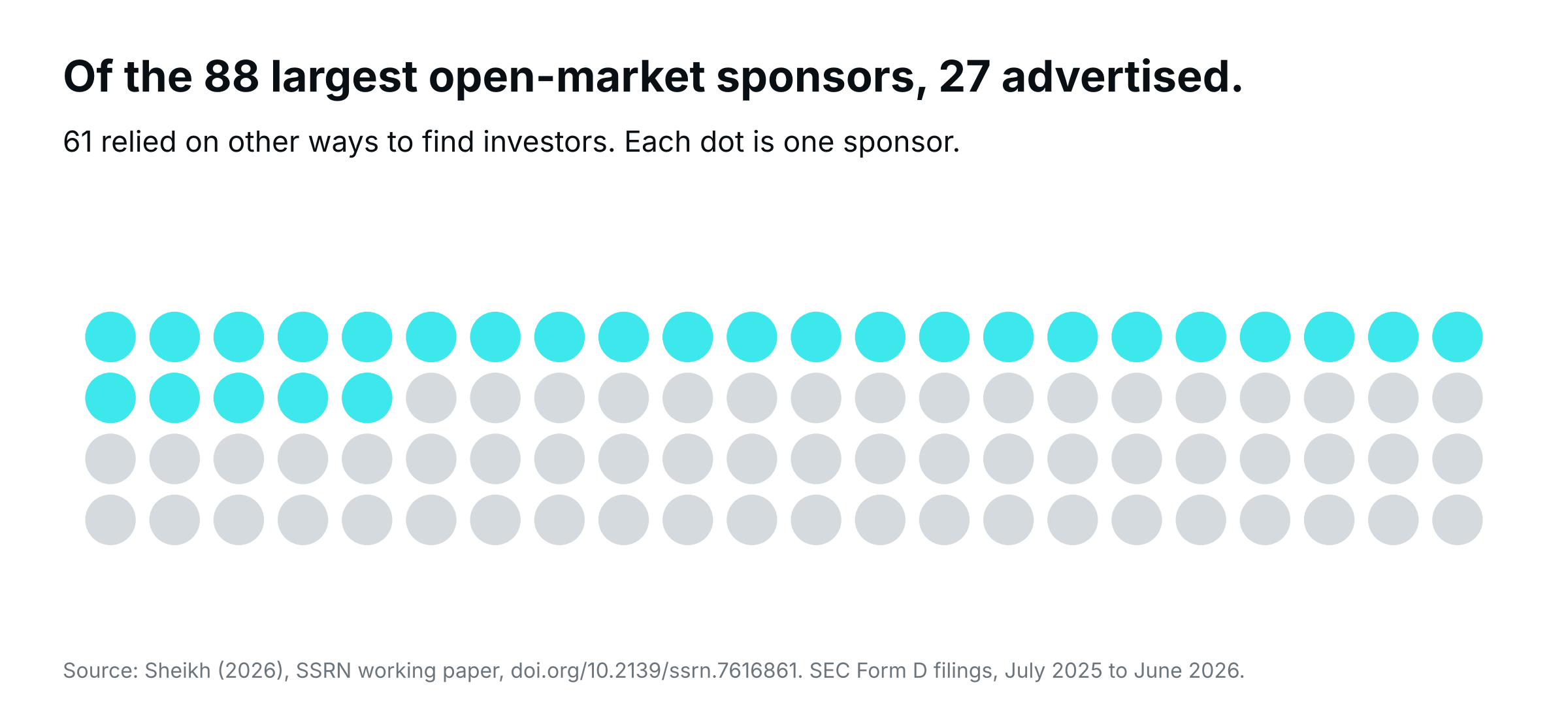
For a sponsor weighing 506(c), that is worth sitting with. Fewer voices in the feed means a clear, honest ad has room to be noticed. The study shows who advertised, not that advertising works for every deal, so treat it as a reason to look closer rather than a promise.

Case study
Our founder built and ran this system in-house at a $1.7 billion real estate manager
Paid reach on more than one platform. A landing page compliance had signed. An accreditation step. A webinar. A follow-up sequence. The same pieces, run as one system.
How much ad budget will your raise take?
Enter your raise, average cheque and timeline. See the investors you need, the leads it takes to find them, and the budget, checked against what 1,180 real estate raises in SEC filings actually did.
Open the plannerNo email needed. Results in under a minute.At our study’s average investment of $128,873, starting with no investors from your own network. Change any number in the planner. Estimates only; real results will vary.
What the rules say
Here are the plain basics, from the SEC’s own pages.
- 506(b) does not allow general solicitation or advertising of the offering. It can include a limited number of non-accredited investors who are financially sophisticated, and that brings extra disclosure work. See the SEC’s page on Rule 506(b).
- 506(c) allows you to advertise the offering broadly, as long as every buyer is accredited and you take reasonable steps to verify it. See the SEC’s page on Rule 506(c).
- Settle which rule you are using with counsel before anything about the deal goes out.
- People paid a commission to bring in investors may need to be registered brokers; ask counsel before you pay anyone for introductions.
Confirm how these apply to your raise with your securities counsel.
Your Form D is public too
Every Regulation D raise comes with a short notice to the SEC called Form D, and anyone can look it up. The SEC’s investor site, Investor.gov, tells investors to check the EDGAR database to see whether a company has filed one. Careful investors do, and so do your competitors.
It shows more than most sponsors realize. The form lists:
- The names of your executive officers, directors and promoters
- Whether you claimed 506(b) or 506(c)
- The minimum investment you accept
- The total offering amount and how much has been sold
- How many investors have invested
- Anyone paid sales compensation for bringing in investors
Treat it as part of your marketing. If your deck says the raise is nearly full and your Form D says otherwise, a careful investor will notice. Make sure the story you tell matches the public record.
It also tells the world which lane you chose. The 506(c) box is how our study counted the raises that relied on it.
Start with where your next investors will come from
The choice is a marketing decision as much as a legal one. Four questions help before the meeting:
- How much equity do you need, and by what date? Write down the closing date and work forward from today.
- How much can your current investors realistically put in? Ask a few before you count on it.
- If there is a gap, who would fill it? If the answer is “people we haven’t met yet”, you are describing a 506(c) raise.
- Do you have the pieces of a public raise ready? A landing page, an intake form, someone to follow up, a way to handle the accreditation check, and time for compliance review. If you plan to share your deal online, see what investors look for on a real estate investment website.
My take: Before the deal goes anywhere public, I’d ask one honest question: can the people who already know us fill this? If the answer is “maybe not”, bring that to counsel early, while every option is still open.
Know your investors first, then choose the rule
If I could offer one thought before that meeting, it would be this: walk in knowing where your next investors will come from. The right rule usually follows. If you’d like to see how a public raise fits together, our 506(c) marketing guide covers the ads, landing pages and investor intake in more detail. And if your next raise is starting to take shape, I’m always glad to talk through where its investors might come from.
Raising in the next six months?
Tell us the raise size, the asset and the close date. We’ll show you where you sit against the 95 sponsors in our audit, and the first thing we’d fix. Fifteen minutes. No deck.
Tell us what you’re raising
One team for the whole raise: the investor website, the ads, the video and design, and the follow-up that turns interest into calls. Send us the raise size, asset and close date, and we’ll reply within one business day with where you sit against the 95 sponsors in our audit.
Questions sponsors ask
Can I post about my deal on LinkedIn under 506(b)?
Not about the offering itself. A public post about a specific deal you are raising for counts as general solicitation, which 506(b) does not allow. You can still post about your company, your market and your approach, as long as nothing reads as an offer.
Is 506(c) riskier than 506(b)?
The rules are different, not looser. Under 506(c) every ad is public and every buyer is checked. Under 506(b) the raise rests on the relationships you have built with the people you invite.
Can I use 506(c) and only take investors I already know?
Yes. You can choose 506(c) and never run an ad, but every buyer still has to be accredited and checked. Some sponsors do this so they keep the option to market publicly later in the raise.
Can I start under 506(b) and move to 506(c) if the raise stalls?
Many sponsors ask this when their circle runs dry. It is a question for your securities counsel, and it is worth asking before the raise opens rather than halfway through.
Will investors really look up my Form D?
Some will, especially experienced ones. The SEC’s investor site tells them to, so make sure what they find matches what you told them.
More guides for sponsors
- How to find investors for real estate: where your next investors come from once friends and family are invested
- How to raise capital for real estate: the raise as a marketing plan, from the deal story to follow-up
- Real estate syndication marketing: how sponsors fill a raise, from the investor package to the investor call
- Marketing a real estate fund: what changes when investors back you, not a building
- What investors look for on a real estate investment website: what our audit of 95 sponsor websites found
- 506(c) marketing: how sponsors advertise: the full guide, with data from 679 sponsors’ filings
This is a marketer’s guide, not legal advice. Confirm your offering’s specifics with securities counsel.
Sources
- SEC, Private Placements: Rule 506(b)
- SEC, General Solicitation: Rule 506(c)
- Investor.gov (SEC), Form D
- SEC, Form D and General Instructions
- SEC Division of Corporation Finance, no-action letter to Latham and Watkins LLP, March 12, 2025
- Skadden, SEC Staff Issues Interpretations on General Solicitation (August 2015)
- SEC Release No. 33-9415, Eliminating the Prohibition Against General Solicitation and General Advertising in Rule 506 and Rule 144A Offerings (2013)
- Sheikh, U. (2026), Who Advertises Under Rule 506(c), and Does It Help? Evidence from the Form D Filings of 679 U.S. Real Estate Sponsors, 2025 to 2026, SSRN
- Web Worx Labs, The 506(c) advertising gap (plain summary of the study)

Usman Sheikh, CPA, is the founder of Web Worx Labs. Qualified as a CPA in Canada and the United States, with twenty years across financial planning and analysis, agency ownership and marketing leadership. Previously Senior Director of Performance and Growth at a $1.7 billion private real estate investment manager in Canada and the US, running investor acquisition across the retail and wholesale channels. Earlier, oil and gas at Saudi Aramco, and campaigns across pharmaceutical, insurance, retail and industrial manufacturing.

About the author
Usman Sheikh, CPA turned marketer
Founder of Web Worx Labs. Twenty years across financial planning and analysis, agency ownership and marketing leadership in retail, manufacturing, energy, pharma, financial services and private equity, including time at Saudi Aramco and as Senior Director of Performance and Growth at a $1.7 billion private real estate investment manager in Canada and the US. CPA in Canada and the United States.
Keep reading
 Real Estate Investment Website: What Investors Look ForBefore they call, they look you up.
 What It Costs to Raise $10 Million With 506(c) AdsWhat a $10 million raise really costs in ads
 Marketing a Real Estate Fund: Investors Back You, Not a BuildingIn a fund, investors back you, not a building.
 Real Estate Syndication Marketing: How Sponsors Fill a RaiseIt starts with a building you can't buy alone.
 How to Raise Capital for Real Estate: A Sponsor’s Marketing PlanMost capital is raised before anyone asks.
 How to Find Investors for Real Estate SyndicationsWhere new investors come from after family and friends.
 506(c) Marketing: The Sponsor’s GuideHow sponsors market a 506(c) offering: what the rule allows, real ads from the most visible sponsors, and what 679 sponsors' SEC...
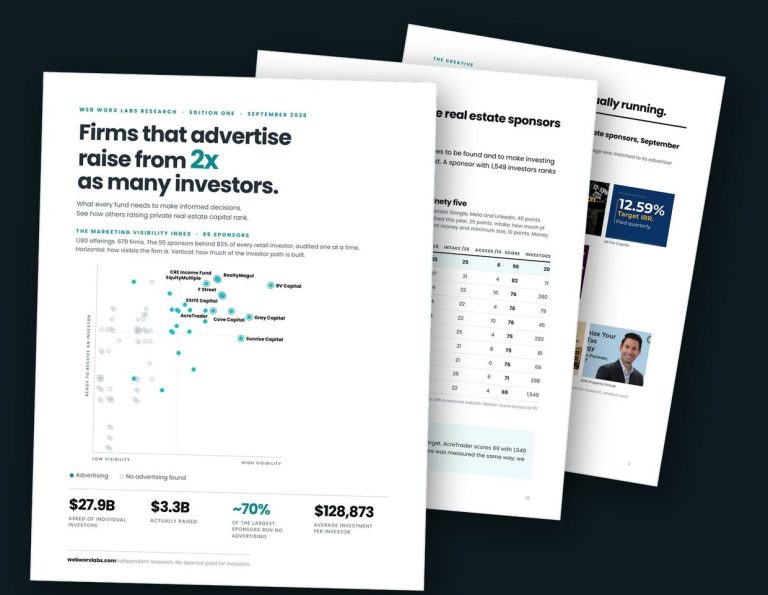 Sponsors asked investors for $27.9 billion last year. They collected $3.3 billion.1,180 real estate raises, 679 sponsors, one year of SEC filings. Seven in ten of the biggest sponsors run no advertising, and...