
 by Usman Sheikh
3 Go-to Social Media Channels For Technical Brands
Published · Updated · By Usman Sheikh, CPA turned marketer
Most industrial social media programs get cancelled in their first year, and the reason is nearly always the same. Somebody bought social media expecting lead generation, and it did not generate leads.
It was never going to. That is not a failure of execution, it is a category error about what the channel does. Here is what it actually does for a technical brand, and here is how I would choose where to spend the effort.
Almost nobody who sees your content can buy from you today
There is a number repeated constantly in B2B marketing: 95 percent of your buyers are out of market at any given moment. It comes from John Dawes at the Ehrenberg-Bass Institute, published through the LinkedIn B2B Institute in 2021.
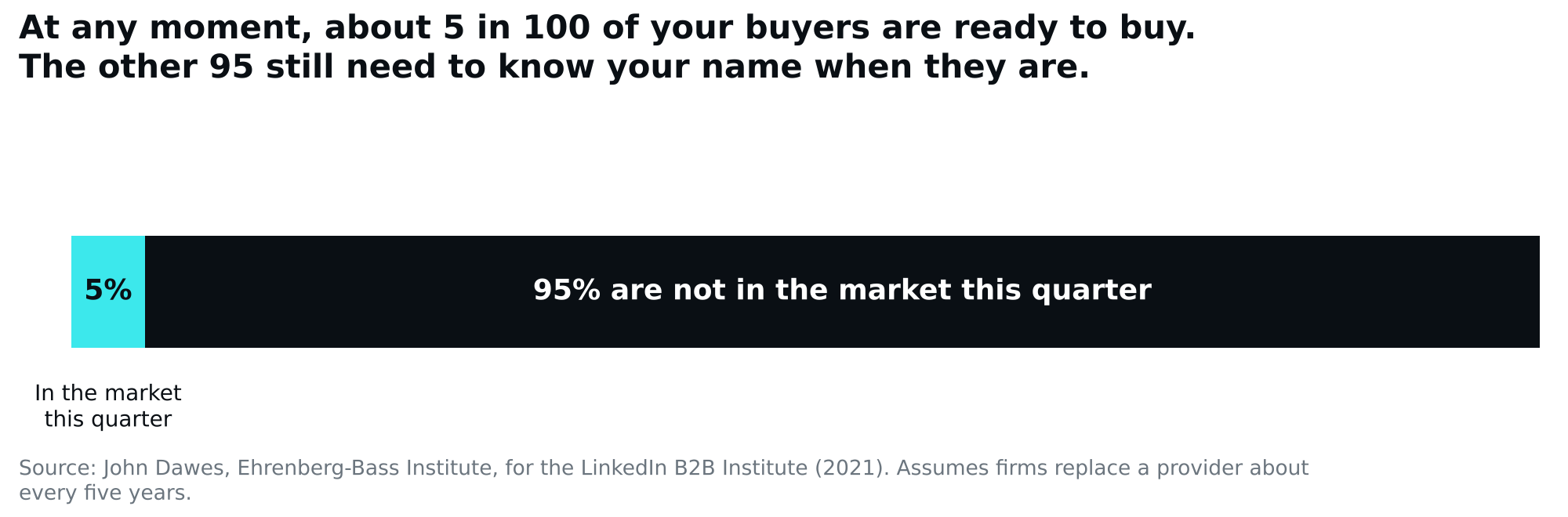
What almost nobody mentions is how that number was produced. It is not a survey. Dawes describes it as arithmetic off the interpurchase cycle. Assume a category where buyers replace roughly every five years, about a fifth are in market in a given year, so roughly 5 percent in a given quarter. That is the whole derivation.
Which matters, because industrial replacement cycles are nothing like five years. If you sell capital equipment that gets replaced every fifteen years, the arithmetic is far harsher than 95:5. If you sell consumables or MRO, it is far kinder.
So do not quote 95:5 at your board. Run the number on your own category using your own replacement cycle. You will get a figure you can actually defend, and a truer picture of what your social media is for.
Whatever number you land on, the conclusion holds. Almost everyone who sees your content today cannot buy from you today. The job is not to capture them. The job is to be the name someone says out loud when the budget finally moves.
Who you are actually reaching
Two things about the audience change the plan.
Industrial buying is a committee. Forrester’s 2026 State of Business Buying found the typical purchase now includes 13 internal stakeholders and nine external influencers. You are not persuading a buyer. You are making sure that when a dozen or more people are in a room asking who they know, somebody says your name.
The technical people in that room have real power. A 2026 study of 750 engineers by EETech found 84 percent are decision makers or strong influencers. The engineer is not a gatekeeper you route around on the way to procurement.
One more number if you sell into Canada. There are 51,353 manufacturing establishments with employees in this country, and only 344 of them have 500 or more people. If large manufacturers are your market, your entire addressable list fits on a spreadsheet you could read in an afternoon. That should change how you think about reach, and about how much of your budget belongs in broadcast at all.
The honest part about ranking channels
Before the list, something you should know about every list like it.
I went looking for credible published research comparing LinkedIn, YouTube, search, trade publications, trade shows and distributor networks for industrial companies specifically. There is none. Not hard to find. None.
The structural reason is that everyone who would fund that research has a direct commercial stake in the answer. The engineering media owners, LinkedIn, the trade show organizers, the distributors. And no government agency, university or neutral association measures it. So when you read a ranked list of the best channels for manufacturers, including this one, understand that the ranking is judgement rather than evidence. Mine comes from watching what works on client accounts. That is worth something. It is not the same thing as data, and anyone presenting it as data is selling you something.
The EETech study puts it about right: no single discovery channel dominates, and engineers self-serve across every stage. Worth knowing that EETech surveyed its own audience, so its channel findings naturally tilt toward engineering media.
1. LinkedIn
LinkedIn earns the first slot for one reason that has nothing to do with engagement rates. It is the only platform where the targeting matches how industrial buying committees are actually built. Job title, seniority, function, company size, industry. You can reach the maintenance manager, the plant director and the procurement lead separately, with different arguments, at the same account.
That is not a lead generation capability. It is a memory building capability aimed at exactly the people who will eventually be in the room.
We took Midas Safety past 56,000 LinkedIn followers as their social agency, organically. No ads, no paid promotion. What did it was regular posting, a rebuilt website, and video interviews with the people who actually make the product. Technical brands underestimate how much authority sits in their own plant.
The honest caveat: this takes years, not quarters. If your CFO needs payback in two quarters, do not start here, because you will cancel it in month nine and conclude that social media does not work for manufacturers.
2. YouTube
YouTube is second because for technical products, demonstration beats description and it is not close. An engineer evaluating a component wants to see it working, see it fail, and see what it looks like installed in a plant that resembles theirs.
The formats that hold up: how it works, how it is installed, how it fails and why, interviews with your own engineers, footage from the floor, and teardown or comparison content where you are honest about where your product is the wrong choice. That last one is the one nobody does and it is the one that builds the most trust.
There is a second reason to be on YouTube in 2026. It is one of the more heavily indexed sources when someone asks an AI assistant how a piece of equipment works. Being the clearest explanation of a technical concept is now a distribution strategy, not just a content one.
3. Wherever your category actually gathers
The third slot is where most articles name a platform. I am not going to, because the honest answer is that it depends on your category and I do not know your category.
For some, it is a trade association forum. For others, a specific subreddit where the maintenance engineers actually talk. For others, a technical publication’s comment section, or a distributor’s own channel, or an annual show where the entire buying population walks past one booth in three days.
The test is simple and it does not require research. Ask your five best customers where they were, and who they were reading or watching, in the six months before they contacted you. Five conversations will tell you more about your third channel than any published list, including this one.
An earlier version of this article named Twitter here, on the strength of a user count from 2022. That was thin then and it is wrong now. If a channel recommendation cannot survive four years, it was never a recommendation, it was a trend.
What this looks like as a plan
- Work out the real in-market percentage for your category from your own replacement cycle, and set the expectation with your CFO before the first post goes out.
- Commit to LinkedIn for at least eight quarters or do not commit at all.
- Put your engineers on camera. The authority is already in the building.
- Find the third channel by asking five customers, not by reading a list.
- Measure share of voice and inbound named-account activity, not leads. If you measure leads you will kill the program before it works.
The deeper version of this argument, including how technical brands should position themselves in the first place, is in marketing technical and complex engineering brands. If you want the channel view specific to manufacturers, that is in social media marketing for manufacturing companies. And if you want to see how we apply this inside a regulated or technical operation, that is our manufacturing practice.
Sources
- John Dawes, Ehrenberg-Bass Institute, The 95-5 Rule, published via the LinkedIn B2B Institute, 2021. johndawes.info/the-955-rule/
- Forrester, The State Of Business Buying, 2026. Survey of nearly 18,000 global business buyers, fielded 2025.
- EETech, Buyer Journey Study 2026. 750 engineers, recruited from EETech’s own communities.
- Innovation, Science and Economic Development Canada, Canadian Industry Statistics, manufacturing (NAICS 31-33), reference year 2025, drawn from Statistics Canada data.

Usman Sheikh, CPA, is the founder of Web Worx Labs. Qualified as a CPA in Canada and the United States, with twenty years across financial planning and analysis, agency ownership and marketing leadership. Previously Senior Director of Performance and Growth at a $1.7 billion private real estate investment manager in Canada and the US, running investor acquisition across the retail and wholesale channels. Earlier, oil and gas at Saudi Aramco, and campaigns across pharmaceutical, insurance, retail and industrial manufacturing.
Work with the author
Want this applied to your business?
Tell me what you sell and who buys it. In fifteen minutes I will tell you what I would fix first. No deck.

About the author
Usman Sheikh, CPA turned marketer
Founder of Web Worx Labs. Twenty years across financial planning and analysis, agency ownership and marketing leadership in retail, manufacturing, energy, pharma, financial services and private equity, including time at Saudi Aramco and as Senior Director of Performance and Growth at a $1.7 billion private real estate investment manager in Canada and the US. CPA in Canada and the United States.
Keep reading
 Med Spa Marketing Agencies in Toronto, Mississauga, Oakville and Burlington: 15 Compared for 202610 GTA med spa marketing agencies, compared on what they actually publish
 7 Steps to Developing a Powerful Brand Positioning StatementIf nobody could disagree with it, nobody will choose you.
 Incompetency & Fakeness Is Amplified in the Digital WorldHow to spot a fake expert before you hire one.
 How Our Brains WorkBuyers pick the brand they remember first.
 Creating Buyer Personas: A Detailed GuideSkip the made-up persona. Map what makes people start looking.
 Testimonial Videos – Ultimate GuideThe best testimonials admit a problem.
 Marketing Technical and Engineering Brands: How to Reach the People Who Actually DecideEngineers don't make the decision alone.
 Social Media for Manufacturing Companies: What to Post, Who Makes It, and Why It WorksPost what only your plant can show.