
 by Usman Sheikh
How Our Brains Work
Published · Updated · By Usman Sheikh, CPA turned marketer
My Morning Coffee Routine
I want to take some time to explain how marketing, directly and indirectly, impacts consumer behaviour, attitudes, and purchases.
This is quite powerful if done right.
To help explain this better, I am going to walk through my morning coffee routine to work.
Who doesn’t like stories?
I wake up in the morning and I am already struggling out of bed.
My brain is still in sleep mode and wants me to keep sleeping.
It is taking all that time and energy to fight off sleep and bring the conscious engine to start warming up again.
I know from habit and experience, I need a kick-start.
Coffee comes to mind.
Because I live in the GTA (in Canada) and near my house, there are literally 5 Tim Hortons within 5 km –Tim’s cursive logo comes to mind.
At this time, it is like a beacon in my mental haze that is guiding my limited motor skills and half-functioning brain towards it.

(This is not me – but I am a zombie most mornings)
I roll into the shower, put on my clothes and drive on over.
I get in the drive-through, I get my coffee without thinking and I am on my way.
I did this for most mornings to work before my kids added a few extra steps.
It was like an auto-pilot.
How did I do this? Why did I form this habit?
My coffee search experience has key benefits where brands have played a key role in forming this habit.
But before connecting my coffee experience with marketing, let’s go back to why I had behaved this way for so many years.
How our brains work
We need our memories to store past experiences.
Our brain is also constantly fighting and creating filters from all the crazy sensory data it is receiving from its five senses and only letting the important ones come to the forefront and become part of our memory system.
This exercise and efficiency come at the expense of the energy required by the brain. We manage this overload by only storing pertinent and useful details to keep ourselves alive and happy.
We store memories for these reasons.
I remember and cherish my kids’ birthdays. My social insurance number. My important passwords and phone numbers.
I remember the nice salad I had at an Italian restaurant last week.
The impactful experiences we remember. Whether it is getting sick or getting hurt. Or it’s enjoying a meal. My first job. My first best friend.
I memorize some things that are connected with my well-being. I commit some things to memory and other things I remember inadvertently.
Our brain protects these memories to keep us stable.
Other memories go into autopilot and routine.
Routine helps with preserving energy and cognitive overload.
Anything that can be used to make it easier to connect and meet our needs in auto-pilot, the better it is.
Our brain’s broader memory network takes advantage of the knowledge that we have built up and uses it each time we meet a problem. The solution is recalled automatically depending on the problem (i.e., getting coffee) or possible new scenarios are played out with higher alert levels depending on the degree of danger to ourselves and the urgency of the problem.
How can brands take advantage of how our brains work?
Why did I remember Timmy’s in the morning say instead of Starbucks (even though I actually enjoy Starbucks’ dry cappuccino more)?
It’s because the brand gurus at Tim Hortons helped me with developing these conditions where the routine could be formed, and we could go into auto-pilot mode.
To achieve this is no easy task.
You would need to invest in physical availability – i.e., 5 Tim Hortons in 5 km of my house.
You would need to make it a pain-free and quick experience given my sleepy brain refusing to wake up – i.e., 30 seconds through the drive-through from order to pickup, and I am out with my morning addiction.
You would need to deliver on a decent experience for me to keep coming back. The product taste (meh), the super quick drive-thru, the low price, the consistent packaging, branding, and sufficient variety to make it easy for my brain to remember.
All of these are crucial.
All of these are major investments that the marketing and leadership team invested in consistently over decades to achieve this auto-pilot story I shared with you today.
This company has reached a very high brand salience in Canada.
Here is an image from the World Coffee Portal that talks about the different coffee brands’ market share. Tim Hortons dominates at 54% in Canada.

Image Source: Snippet from a news article on World Coffee Portal.com
It did so by investing in:
- Physical availability (network of stores easily accessible)
- Mental availability (easy to remember and consistent branding throughout the years)
- Keeping freshness factors high for recall (I see them everywhere, in skating arenas, ads, gas stations, events and you name it)
All of these are marketing activities that build the brand.
It’s only getting harder to stay fresh
If brands are not investing in physical availability, freshness factors, and mental availability – they will have a hard time growing.
This is especially true for B2C brands. But it is increasingly true with B2B brands.
Brands need to invest in creatives, assets, and processes to always make it easy for their customers or clients to do business with them.
If you are a B2B business, how can you make your processes easier so that even complex deals can be broken down into sub-tasks and activities so you can have your customers buy online initially as the first step to a bigger contract?
If you are a B2C brand manager – how can you keep your freshness factors high where your brand is top of mind consistently so when the consumer is hungry, looking for shoes or general merchandise – your brand is the one they consider?
As shown in the story above – it is by investing in building your assets that are creative, speak directly to your customers so they can form memories for brand recall.
To form memories where your brain is always looking to filter out noise, your creative assets and marketing have to stand far above the ads, social posts and other messages competing for the same attention.
We see thousands of ads a day. The figure everyone quotes, about 5,000 a day, is a 2007 estimate from the research firm Yankelovich, reported by the New York Times. Nobody has measured it properly since, so treat it as a rough order of magnitude, not a fact.
I cannot recall more than five of them if I try.
Image Source: Web Archive From NY Times Article in 2007
The five ads I did remember are the ones that made an impact.
Taking shortcuts in building brand assets is going to make it harder for your brand to be found.
Growing becomes harder.
It is one reason so many businesses fail. They are not able to appeal to enough new customers before they run out of cash to cover their expenses.
The cause of not getting found is because their marketing strategies are focusing on short-term wins instead of long-term brand plays.
For brands to sustain and gain a level of salience required that big brands have achieved will require investments.
If you are looking to gain customers and you are in the short-term to get quick wins and that is taking 70% of your marketing expenses, your business will likely suffer over the long term.
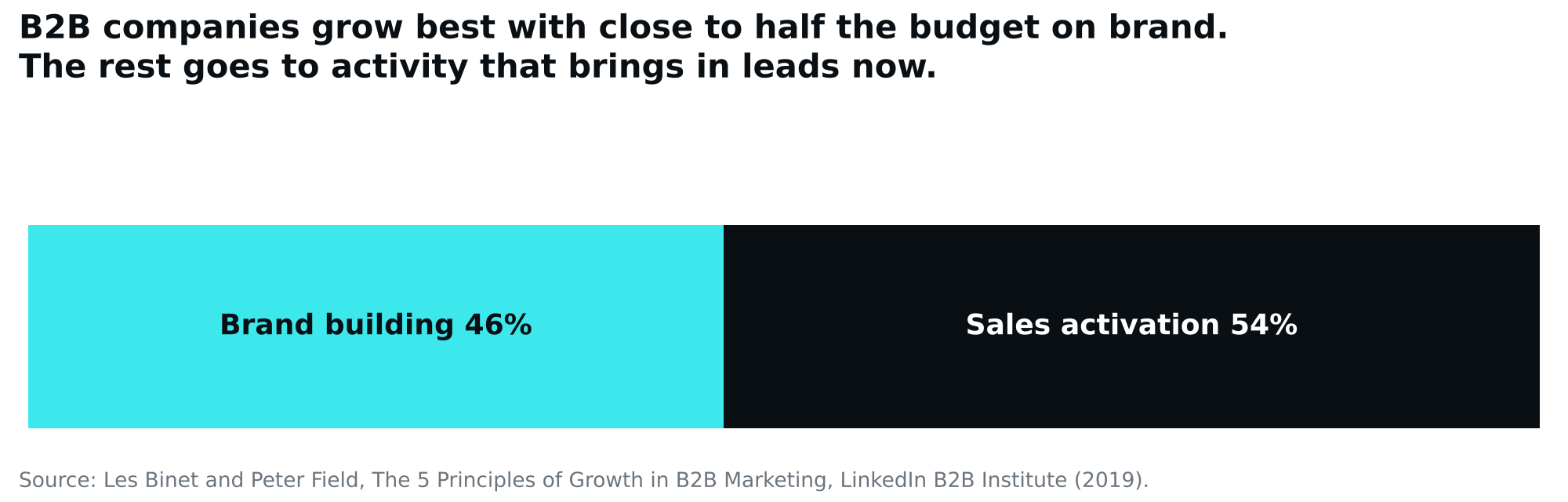
Invest in assets, messages, and brand experiences that will help with forming habits and memories.
(Oh, and Tim Hortons marketing team – you are welcome for the free exposure in my blog).
The same thing happens in business buying, and it is worth more there
Everything above is a consumer story, because coffee is easy to see. The mechanism does not change when the purchase is a million dollar piece of equipment or a marketing agency for a regulated firm. It just gets slower and the stakes get higher.
The Ehrenberg-Bass Institute calls the trigger situations category entry points. Jenni Romaniuk’s work on mental availability is built on the idea that a brand grows by being linked in memory to more of those situations, not by being loved more deeply by the same people. Tim Hortons is not winning because people feel strongly about it. It is winning because it got attached to a very ordinary situation, which is being half asleep on the way to work.
In business buying, the situations are things like an examination finding, a failed line, a certification renewal, a compliance officer leaving, or a budget cycle opening. Your job is the same job Tim Hortons has. Be the name that surfaces in that moment.
Why this is harder in B2B, and why most companies get the budget wrong
Almost nobody who sees your marketing today can buy from you today. You hear the figure 95 percent quoted for this, from work published through the LinkedIn B2B Institute in 2021.
Worth knowing what that number actually is. John Dawes at Ehrenberg-Bass derived it arithmetically from an assumed five year purchase cycle, not from a survey. So it is not a fact about your category, it is a worked example. Run the same arithmetic on your own replacement cycle. If you sell capital equipment replaced every fifteen years, the real figure is far harsher. If you sell consumables, it is far kinder.
Either way the conclusion is the one in the coffee story. You are not persuading anyone today. You are building the memory that gets retrieved on the day they are finally in the market, which might be four years from now.
That is an uncomfortable thing to take to a CFO, and it is the reason most brand work in business to business gets cancelled in month nine, right before it starts to pay.
Where to go next
The practical version of this, for identifying your own trigger situations rather than writing fictional personas, is in creating buyer personas. If you want to see it applied to industrial and technical companies, that is in marketing technical and complex engineering brands.
Sources
- World Coffee Portal, Canadian coffee market share, 2020, linked above.
- Jenni Romaniuk, Ehrenberg-Bass Institute, on mental availability and category entry points. The published empirical work is largely drawn from consumer categories, so the business to business application here is an extension of the concept rather than a separately evidenced finding.
- John Dawes, Ehrenberg-Bass Institute, The 95-5 Rule, published via the LinkedIn B2B Institute, 2021. Derived arithmetically from an assumed interpurchase cycle rather than measured by survey.
The coffee market share figure dates from 2020 and has not been re-verified.

Usman Sheikh, CPA, is the founder of Web Worx Labs. Qualified as a CPA in Canada and the United States, with twenty years across financial planning and analysis, agency ownership and marketing leadership. Previously Senior Director of Performance and Growth at a $1.7 billion private real estate investment manager in Canada and the US, running investor acquisition across the retail and wholesale channels. Earlier, oil and gas at Saudi Aramco, and campaigns across pharmaceutical, insurance, retail and industrial manufacturing.
Work with the author
Want this applied to your business?
Tell me what you sell and who buys it. In fifteen minutes I will tell you what I would fix first. No deck.

About the author
Usman Sheikh, CPA turned marketer
Founder of Web Worx Labs. Twenty years across financial planning and analysis, agency ownership and marketing leadership in retail, manufacturing, energy, pharma, financial services and private equity, including time at Saudi Aramco and as Senior Director of Performance and Growth at a $1.7 billion private real estate investment manager in Canada and the US. CPA in Canada and the United States.
Keep reading
 Med Spa Marketing Agencies in Toronto, Mississauga, Oakville and Burlington: 15 Compared for 202610 GTA med spa marketing agencies, compared on what they actually publish
 7 Steps to Developing a Powerful Brand Positioning StatementIf nobody could disagree with it, nobody will choose you.
 Incompetency & Fakeness Is Amplified in the Digital WorldHow to spot a fake expert before you hire one.
 3 Go-to Social Media Channels For Technical BrandsSocial media builds trust. It rarely brings leads.
 Creating Buyer Personas: A Detailed GuideSkip the made-up persona. Map what makes people start looking.
 Testimonial Videos – Ultimate GuideThe best testimonials admit a problem.
 Marketing Technical and Engineering Brands: How to Reach the People Who Actually DecideEngineers don't make the decision alone.
 Social Media for Manufacturing Companies: What to Post, Who Makes It, and Why It WorksPost what only your plant can show.