
 by Usman Sheikh
How to Find Investors for Real Estate Syndications
Published · By Usman Sheikh, CPA turned marketer
Your first investors were probably people who already trusted you. A brother, a spouse, a close friend, a colleague who’d watched you work for years.
That’s how most sponsors start, and it’s a good start. Those people back you, not the building.
If you want help reaching new accredited investors, see how our 506(c) marketing agency works.
The harder question comes a few deals later, when the people closest to you are already invested and the next building needs more than they can give. That’s where most sponsors stall, and where the work of finding new investors really begins.
This guide walks through where accredited investors come from once your own circle is tapped, what each source involves, and how to start building those relationships ahead of your next raise.
Investors come from six places, and each one asks something different of you
Every investor in your raise arrived through one of six routes. They differ in warmth, cost, and who keeps the relationship afterwards.
- Your own network and referrals. Past investors, colleagues, your accountant, your lawyer, your lender, and the people they introduce. Local investor clubs and meetups count too. This is the warmest source, and it grows only as fast as people talk about you.
- Your own audience. An email list, a newsletter, LinkedIn posts, articles, a podcast, and regular investor education calls. Over months, strangers become people who know you.
- Paid advertising under 506(c). Ads on LinkedIn, Google or Meta that send people to your landing page. Open only to 506(c) raises, and best when the landing page and follow-up are ready first.
- Platforms and marketplaces. Online sites that list sponsor deals for their accredited members. They bring an audience you did not build, for a fee. Ask who owns the investor relationship before you sign.
- Broker-dealers. A registered broker-dealer can place your offering with its clients for a fee.
- Bought lists. Names sold as “accredited” or “high net worth.” Quick and cheap per name, but nobody on the list has heard of you, and the names age fast.
Referrals and your own audience are the warmest sources, and the only ones you fully keep
How the six sources compare on warmth, effort and who owns the relationship once the raise is done.
| Source | How warm the investor is | What it asks of you | Who keeps the relationship |
|---|---|---|---|
| Network and referrals | Warmest: they know you, or someone who does | Time, and asking well | You |
| Your own audience | Warms up over months | Regular emails, calls and content | You |
| Paid ads (506(c) only) | Cold at first | Ad budget, a landing page, fast follow-up | You, once they join your list |
| Platforms | Lukewarm: they trust the platform first | Fees and the platform’s terms | Often shared; read the terms |
| Broker-dealers | Warm to the broker, not yet to you | Fees and a selling agreement | Usually the broker |
| Bought lists | Cold | Money, plus care with email and phone rules | A list that ages quickly |
My take: Your own network will always be the heart of your raise, and it should be. What I’d suggest is adding one source you own alongside it, an email list or a regular investor call, so the people your investors mention have somewhere to go.
Among bigger raises, the sponsors who advertised reported more investors
We read a year of SEC Form D filings from US real estate sponsors, July 2025 to June 2026. We also checked major sponsors’ websites and public ad libraries by hand. The full method is in our study of the 506(c) advertising gap.
The gap grew as the raises got bigger. Below a $10 million target the two groups looked alike: a median of 46 investors for sponsors who advertised and 53 for those who did not. From $10 million to $30 million it was 81 against 48. From $30 million to $100 million it was 137 against 60.
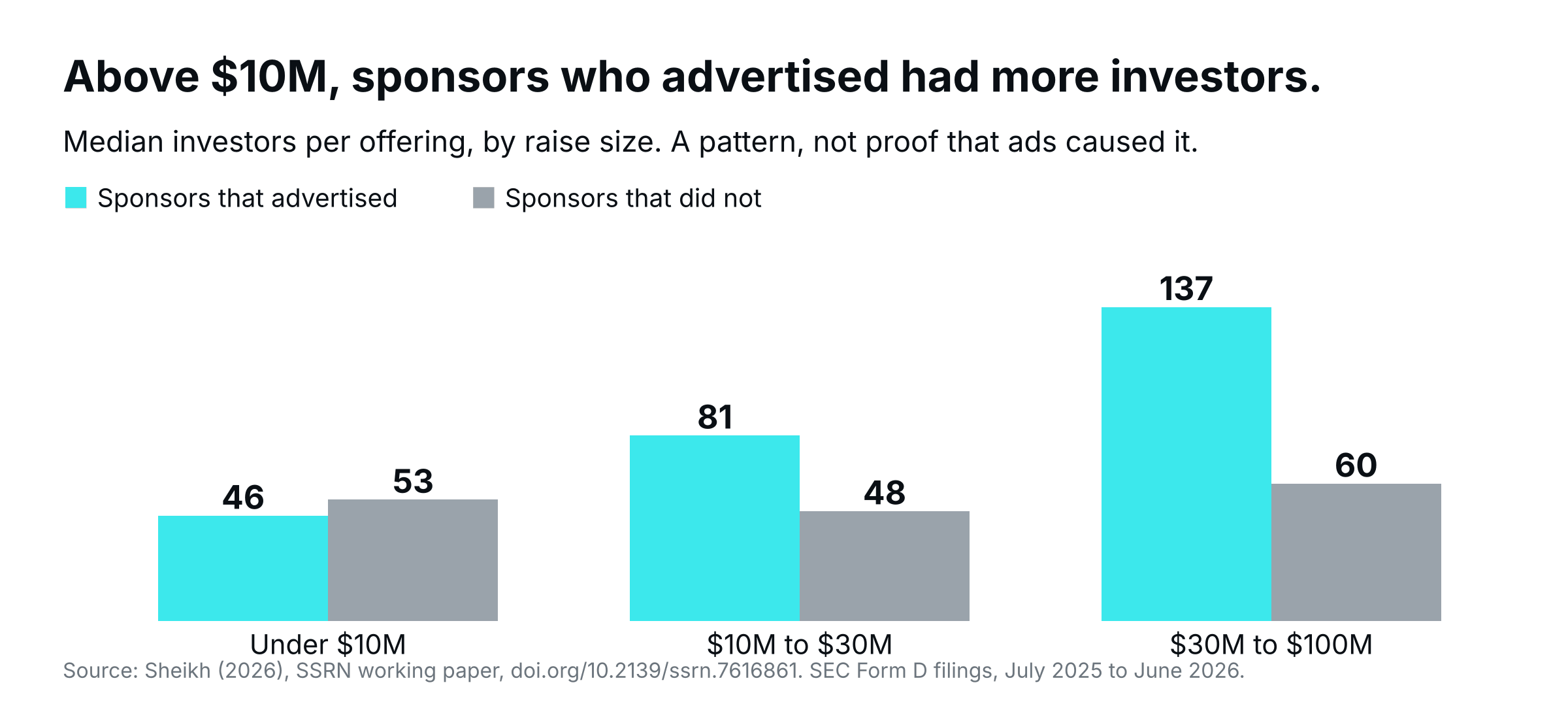
Read those numbers as an association, not proof. Sponsors who advertise may differ in other ways, such as brand, track record or team size. The data shows the two go together. It does not show that advertising caused the difference.
What it does suggest is simple. A small raise can be filled by people who already know you. A bigger raise needs more people, and the sponsors who reached past their own circle tended to have more of them.
Your first investors back you. The next ones need a way to find you.
Case study
Our founder built and ran this system in-house at a $1.7 billion real estate manager
Paid reach on more than one platform. A landing page compliance had signed. An accreditation step. A webinar. A follow-up sequence. The same pieces, run as one system.
How much ad budget will your raise take?
Enter your raise, average cheque and timeline. See the investors you need, the leads it takes to find them, and the budget, checked against what 1,180 real estate raises in SEC filings actually did.
Open the plannerNo email needed. Results in under a minute.At our study’s average investment of $128,873, starting with no investors from your own network. Change any number in the planner. Estimates only; real results will vary.
Referrals come easier when you ask at the right moment and make it easy to say yes
Most sponsors know referrals matter, and most ask for them badly. A line at the bottom of an update saying “let us know if you know anyone” rarely moves anyone.
- Ask after good news. The best time is right after a distribution, a refinance, or an update where the plan is on track.
- Ask in person or by phone. A short call to thank someone, followed by one question, works better than a mass email. “Is there anyone in your circle who has asked you about the deal?” is easier to answer than “Do you know any investors?”
- Give them something easy to pass on. An invitation to your next investor education call, a link to join your email list, or a short note about how you invest. Something general and useful, not the offering itself.
- Close the loop. When someone introduces a friend, thank them, and let them know you followed up. People keep referring sponsors who treat their friends well.
Your advisers can refer too. Accountants, attorneys and lenders meet people with money to invest every week. Keep them informed so you come to mind when a client asks.
What to send people who join your list, starting on day one
The first message matters most. Someone who joins your list is curious right now. If they hear nothing for six weeks, that curiosity is gone.
- A welcome email the same day. Who you are, what you buy and where, a short summary of your track record, and how often you will write. Keep it warm and plain.
- A one page “how we invest” summary. Your strategy, the kind of buildings you look for, how you think about risk, and how investors have been paid on past deals.
- A monthly update. One useful note on your market or a property you own: a renovation finished, a lease-up milestone, a lesson learned. Real photos of real buildings do more than charts.
- An invitation to a call. A short online session every quarter on how you underwrite a deal, with time for questions.
- An easy way to talk to you. A calendar link in every email, so anyone who is ready can book a time without waiting for you to reach out.
Be honest in your updates, including when something goes wrong. An honest update sent on time builds more trust than a polished one sent late.
My take: If a bought list is tempting because the raise feels close, I understand. What I’d suggest is putting that money into a simple landing page and this welcome sequence instead. It is slower, but the people who join chose to hear from you, and they are still there for the deal after this one. Our guide to a real estate investment website covers what that page needs.

Before investors say yes, they look for the same few things
Finding investors and winning them are two different jobs. Once someone is interested, they tend to look for these before they commit.
- Your track record, in plain numbers: past deals, what you projected and what actually happened.
- The story of the deal: why this building, this market, and now.
- The risks, named clearly, and how you will handle them.
- How and when they get paid, and how the deal ends: a sale or a refinance.
- The building and the people: photos, a walkthrough, or a site visit for your warmest prospects.
What the rules say about finding investors
Your offering type decides what you can say in public. Under Rule 506(b) you cannot use general solicitation or advertising to market the offering, so keep public content educational and away from any live deal. Rule 506(c) lets you advertise broadly, as long as every buyer is an accredited investor and you take reasonable steps to verify that. Email and text outreach has its own rules too: the FTC’s CAN-SPAM compliance guide covers commercial email, and calls and texts have separate consent rules. People paid a commission to bring in investors may need to be registered brokers, so ask counsel before agreeing to any success fee. Confirm the specifics of your raise with your securities counsel.
For a deeper look at how the two options change your marketing, read our guide to 506(b) vs 506(c).
A 90 day plan for a sponsor starting with a small network
This plan assumes a track record, a few dozen warm contacts, and a deal coming in the next six months.
- Days 1 to 10: write down everyone. Put every past investor, co-investor, lender, broker, accountant and attorney you know into one spreadsheet or CRM.
- Days 11 to 20: settle 506(b) or 506(c) with counsel. The choice decides what you may say in public. If you are not sure yet, keep public content educational and away from any live deal.
- Days 21 to 30: build one place for people to land. A simple page that explains your strategy, your track record and how to join your investor list. Add an intake form that asks how much someone usually invests and how they prefer to be contacted, with a checkbox for consent to calls and texts.
- Days 31 to 45: call your past investors. Thank them, share how the last deal is doing, and ask who in their circle has asked about it. Log each referral.
- Days 46 to 60: start the monthly email and one investor call. Turn on the welcome email, send your first monthly update, and host one short online call on how you underwrite a deal. Invite everyone on the list and every referral.
- Days 61 to 75: get the paperwork ready. Have your investor summary, track record page and site visit plan ready, and agree with counsel how accredited status will be confirmed if you are on 506(c).
- Days 76 to 90: test one paid channel, if you are on 506(c). Run a small LinkedIn or Meta campaign that sends people to your landing page. Track cost per sign-up and how many book a call. If you are on 506(b), spend this time on referrals and a property tour for your warmest contacts instead.
At day 90 you should have three things: a clean list with consent on file, a monthly rhythm of contact, and a clear way to bring new people in. Those carry into every raise after this one. When the deal is ready, our guide on how to raise capital for real estate covers the raise itself.
Build the list now, before the next building goes under contract
Your first raise came from people who already knew you, and the next one can too. The difference is giving more people the chance to know you before the clock starts. If I were in your seat, I’d begin with the list and the welcome email, then read our 506(c) marketing guide for the channels and our study of the 506(c) advertising gap for the data. And if your next raise is already on the calendar, I’d be glad to talk through where those investors could come from.
Raising in the next six months?
Tell us the raise size, the asset and the close date. We’ll show you where you sit against the 95 sponsors in our audit, and the first thing we’d fix. Fifteen minutes. No deck.
Tell us what you’re raising
One team for the whole raise: the investor website, the ads, the video and design, and the follow-up that turns interest into calls. Send us the raise size, asset and close date, and we’ll reply within one business day with where you sit against the 95 sponsors in our audit.
Questions sponsors ask
How do I find investors for real estate if I have never raised before?
Start with people who already know your work: colleagues, past business partners, your own professional advisers and their introductions. Build an email list and share how you think about deals before you have one. Investors who have watched you for months are far more likely to invest than strangers.
Can I advertise my real estate deal on social media?
Only if the offering relies on Rule 506(c). Then every buyer must be accredited and you must take reasonable steps to verify that. Under 506(b), keep public posts educational and away from any live offering, and check with counsel.
Should I buy a list of accredited investors?
It is fast, but it is usually the weakest source. The people on it do not know you, the names age quickly, and email and phone outreach to them carries its own rules. The same money spent on a landing page and a monthly email tends to give you people who chose to hear from you.
Can I pay someone a commission for bringing in investors?
Be careful. The SEC’s Guide to Broker-Dealer Registration says people who find investors for issuers may need to register as brokers, especially when their pay depends on the size or outcome of the deal. Ask securities counsel before agreeing to any success fee.
More guides for sponsors
- How to raise capital for real estate: the raise as a marketing plan, from the deal story to follow-up
- 506(b) vs 506(c): what each rule lets you say about your raise, and where you can say it
- Real estate syndication marketing: how sponsors fill a raise, from the investor package to the investor call
- Marketing a real estate fund: what changes when investors back you, not a building
- What investors look for on a real estate investment website: what our audit of 95 sponsor websites found
- 506(c) marketing: how sponsors advertise: the full guide, with data from 679 sponsors’ filings
This is a marketer’s guide, not legal advice. Confirm your offering’s specifics with securities counsel.
Sources
- Sheikh, U. (2026). Who Advertises Under Rule 506(c), and Does It Help? Evidence from the Form D Filings of 679 U.S. Real Estate Sponsors, 2025 to 2026. SSRN.
- Web Worx Labs. The 506(c) advertising gap (plain summary of the study).
- U.S. Securities and Exchange Commission. Private placements: Rule 506(b).
- U.S. Securities and Exchange Commission. General solicitation: Rule 506(c).
- Investor.gov, U.S. Securities and Exchange Commission. Accredited investors.
- U.S. Securities and Exchange Commission. Guide to Broker-Dealer Registration.
- Federal Trade Commission. CAN-SPAM Act: A Compliance Guide for Business.
- eCFR. 47 CFR 64.1200, Delivery restrictions (rules for calls and texts).

Usman Sheikh, CPA, is the founder of Web Worx Labs. Qualified as a CPA in Canada and the United States, with twenty years across financial planning and analysis, agency ownership and marketing leadership. Previously Senior Director of Performance and Growth at a $1.7 billion private real estate investment manager in Canada and the US, running investor acquisition across the retail and wholesale channels. Earlier, oil and gas at Saudi Aramco, and campaigns across pharmaceutical, insurance, retail and industrial manufacturing.

About the author
Usman Sheikh, CPA turned marketer
Founder of Web Worx Labs. Twenty years across financial planning and analysis, agency ownership and marketing leadership in retail, manufacturing, energy, pharma, financial services and private equity, including time at Saudi Aramco and as Senior Director of Performance and Growth at a $1.7 billion private real estate investment manager in Canada and the US. CPA in Canada and the United States.
Keep reading
 Real Estate Investment Website: What Investors Look ForBefore they call, they look you up.
 What It Costs to Raise $10 Million With 506(c) AdsWhat a $10 million raise really costs in ads
 Marketing a Real Estate Fund: Investors Back You, Not a BuildingIn a fund, investors back you, not a building.
 Real Estate Syndication Marketing: How Sponsors Fill a RaiseIt starts with a building you can't buy alone.
 506(b) vs 506(c): Can You Advertise Your Next Raise?One meeting with your lawyer shapes the whole raise.
 How to Raise Capital for Real Estate: A Sponsor’s Marketing PlanMost capital is raised before anyone asks.
 506(c) Marketing: The Sponsor’s GuideHow sponsors market a 506(c) offering: what the rule allows, real ads from the most visible sponsors, and what 679 sponsors' SEC...
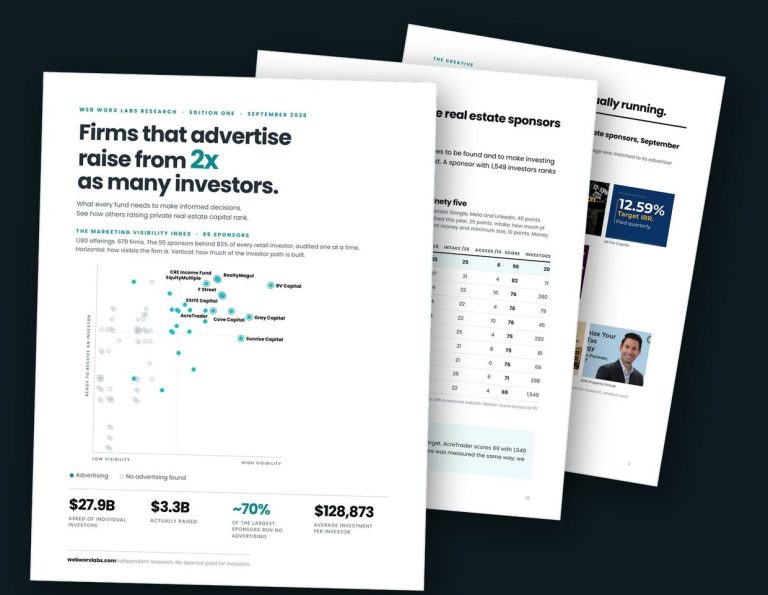 Sponsors asked investors for $27.9 billion last year. They collected $3.3 billion.1,180 real estate raises, 679 sponsors, one year of SEC filings. Seven in ten of the biggest sponsors run no advertising, and...