
 by Usman Sheikh
Marketing a Real Estate Fund: Investors Back You, Not a Building
Published · By Usman Sheikh, CPA turned marketer
In a syndication, investors can tour the building. In a fund, what they’re really evaluating is you.
Most sponsors get to this point slowly. The first deal was backed by people who already knew you: a brother, a spouse, a colleague who had watched you work. A few deals later, some of those same people are asking what’s next before you even have a building to show them.
For funds raising under 506(c), see how our 506(c) marketing agency finds accredited investors.
That is usually when the idea of a fund comes up. Maybe you have lost a good building or two because the money could not come together in time, and capital committed in advance starts to sound like relief.
It can be. But a fund asks your investors to back your judgment before they have seen the buildings, and that changes the raise, the paperwork and the way you talk about your work.
If you are weighing that move, this guide walks through the marketing side of it: your track record, your strategy, trust before launch, and a longer raise.

A syndication sells one building; a fund sells the sponsor
In a single-asset syndication, the property comes first. You tie up a building, then raise equity for it. As a June 2020 article from the US law firm Akerman LLP puts it, in a single-property syndication the “investment capital is committed to one asset class, one geographic location, one property manager, one investment strategy.”[2]
A fund pools capital across several assets. The same Akerman article notes that most real estate funds use a blind or semi-blind structure, meaning only one or some of the assets have been identified when an investor commits. In practice there are three versions:
- Blind pool. No assets identified. Investors commit to a strategy, a market and a team.
- Semi-blind. One or a few seed assets are identified or already owned, and the rest of the capital goes out later.
- Specified fund. All target assets are named up front, much like a multi-property syndication.
Funds also run on a clock. An American Bar Association primer on real estate private equity funds, published in its September/October 2023 issue of Probate & Property, says a typical closed-end fund term is ten years, so investors are signing up for a long relationship with you, not one business plan.[3]
The Akerman article puts it simply: “The trust and integrity of the sponsor or fund manager is of critical importance.”[2] That is the whole marketing job in one line. Everything below is about earning that trust in a way an investor can see and check.
Your track record is the product, so show all of it
In a fund, the record takes the place of the property tour. Investors want each past deal: what you bought, what the plan was, what happened, and what the investors actually received after fees. Present every deal the same way so they can compare one with another.
Include the deals that did not go to plan, and the ones still in progress. A record with only wins invites the question of what else is missing. A deal that went sideways, explained plainly with what you learned, often builds more trust than another success story.
Have the record checked before anyone sees it. The ABA primer says the track record should be reviewed carefully by counsel.[3] Numbers that change between the deck and the website lose careful investors fast.
Six questions fund investors ask, and what to show them
Your answers to these become the fund’s marketing: the deck, the website, the webinar and the first email.
| What the investor is asking | What to show them | Where it goes |
|---|---|---|
| Have you done this before? | Every past deal in the same strategy, with results to investors after fees, including the ones that went badly | Deck, website, webinar |
| What will you buy? | The strategy in plain words: asset type, markets, deal size, and what you will not buy | One-page summary, website |
| Why now? | The market story: what has changed and why your strategy fits it | Webinar, email, LinkedIn posts |
| Is there anything real yet? | A seed asset or a deal under contract, with real photos and the business plan | Deck, investor call, site visit |
| Who else is in? | Your own commitment and progress toward first close, shared as it happens | Email updates, investor call |
| How will I hear from you? | A sample quarterly update from a past deal | Deck appendix, follow-up email |
Among $30 million to $100 million raises, advertisers reported a median of 137 investors, not 60
A fund raise usually takes longer than a deal. In a 2013 interview with REFM, Wharton emeritus professor Peter Linneman said it is “much harder to raise money for real estate private equity funds because of their nature as “trust-me” vehicles.” In his example, a blind pool may take two years to raise, while a single deal may take three to six months.[4]
That makes reach matter more. Our study of SEC Form D filings from July 2025 to June 2026 compared offerings by size. Among those targeting $30 million to $100 million, sponsors that advertised reported a median of 137 investors against 60 for those that did not. That is an association, not proof that advertising caused the difference.

A raise for an unnamed portfolio needs a wider investor base than the circle that backed your first building. Our 506(c) advertising study has the full data.
In a syndication the building closes the raise. In a fund, your record does.
Case study
Our founder built and ran this system in-house at a $1.7 billion real estate manager
Paid reach on more than one platform. A landing page compliance had signed. An accreditation step. A webinar. A follow-up sequence. The same pieces, run as one system.
How much ad budget will your raise take?
Enter your raise, average cheque and timeline. See the investors you need, the leads it takes to find them, and the budget, checked against what 1,180 real estate raises in SEC filings actually did.
Open the plannerNo email needed. Results in under a minute.At our study’s average investment of $128,873, starting with no investors from your own network. Change any number in the planner. Estimates only; real results will vary.
The thesis is a story investors should be able to repeat
Your strategy needs to fit in two sentences. What you buy, where, and why you can do it better than most. If an investor cannot explain it to their spouse over dinner, it is not clear enough yet.
Then tell the market story behind it. What changed in your markets, what you are seeing on the ground, and why your approach fits this moment. Use what you know first hand: rents you have signed, buildings you have walked, the kind of sellers you are meeting.
My take: What I’d suggest is writing the thesis before the deck. Once the two sentences are right, the deck, the website, the webinar and the first email almost write themselves, and they all say the same thing.
Build trust before the fund opens
The best fund raises start warm. Use the months before launch to give people reasons to know you, so the first calls are with people who have been following along.
- Deal recaps. A short, honest write-up of each deal you have finished: the plan, what happened, what you learned.
- Market notes. A monthly email or LinkedIn post on what you are seeing in your markets, written in plain words.
- An email list you own. Every past investor, every referral and every person who has asked about your next deal, in one place.
- A way to enquire that works. A simple page where an interested investor can join the list, book a call or ask a question. Our guide to finding investors for real estate covers where new names come from.
- An educational webinar. How you find deals, run buildings and report to investors.
A fund raise runs for months, so plan for momentum
Most closed-end funds raise in stages. In a February 2021 article, Matthew Ertman of the law firm Allen Matkins describes an initial closing of subscriptions from investors, then subsequent closings for additional investors over an offering period of 12 to 18 months.[5] The ABA primer gives the same typical range for the marketing period.
The first close is your biggest marketing moment. It turns “we are raising” into “we are investing”, and it gives everyone still deciding a reason to look again. The ABA primer notes that sponsors often offer first close investors certain economic benefits, such as a management fee holiday, to encourage them to commit early.[3]
A seed asset is the best proof you can offer. In a semi-blind fund, one building already owned or under contract gives investors something real to look at, tour and ask about. Photos, the business plan and early numbers from that building do more than any slide about the strategy.
Give the pipeline something new to hear every few weeks. A new building under contract, the first close, a site visit, a quarterly update on the seed asset. Each one is a reason to email the people who said “not yet”, without asking them again.
Track where commitments come from. Note for each investor whether they came from a past deal, a referral, the webinar, a post or an ad. Halfway through a long raise, that tells you where to spend the rest of your time.
Investor updates are the marketing for your next fund
Your current investors are the first people your next fund will ask. How you report now decides that conversation.
Keep updates regular, plain and the same shape each time. What you bought, how each building is doing against plan, what is coming next, and what investors received. Share bad news early and in the same tone as good news.

What the rules say about marketing a fund
A fund is a bigger legal setup than a single deal. There are usually more entities, more documents and more decisions about how the fund will run, so bring in counsel who works on funds early, before the deck or the website is drafted.
The marketing difference comes down to one choice. Under Rule 506(b), the offering cannot be advertised, so you raise through people you already know; under Rule 506(c), it can be advertised openly, but every investor must be accredited and the sponsor must take reasonable steps to verify it. Our guide to 506(b) vs 506(c) covers what each one lets you say and where.
Confirm the specifics with your securities counsel before anything about the fund goes public.
Funds and syndications draw on the same investors
What changes is what you ask them to trust. In a syndication it is a building and a plan. In a fund it is you, your record and your judgment over the years ahead.
I’m always glad to think through where those investors will come from with a sponsor. If you are still a deal or two away from a fund, our guide to real estate syndication covers that stage, and our 506(c) marketing guide covers how sponsors reach accredited investors they have not met yet.
Raising in the next six months?
Tell us the raise size, the asset and the close date. We’ll show you where you sit against the 95 sponsors in our audit, and the first thing we’d fix. Fifteen minutes. No deck.
Tell us what you’re raising
One team for the whole raise: the investor website, the ads, the video and design, and the follow-up that turns interest into calls. Send us the raise size, asset and close date, and we’ll reply within one business day with where you sit against the 95 sponsors in our audit.
Questions sponsors ask
What is a real estate fund?
A real estate fund pools capital from many investors to buy several properties, usually under one fund entity run by the sponsor. Investors often commit before most or all of the assets are chosen, which is why the sponsor’s record matters so much.
Is a real estate private equity fund different from a real estate fund?
In practice, the terms overlap. “Real estate private equity fund” usually means a closed-end private fund with a set term and a share of profits for the sponsor. “Real estate fund” can also mean public REITs or real estate mutual funds.
How do I start a real estate fund?
From the marketing side, start with a track record in one strategy and a group of repeat investors who know your work. Write the thesis, build your list and your way to enquire, and bring in fund counsel early. Then plan a raise that runs over months rather than weeks.
How long does it take to raise a real estate fund?
Longer than a single deal. Many closed-end funds hold a first close and then further closings over a marketing period of around 12 to 18 months. A first-time blind pool can take longer still.
More guides for sponsors
- How to find investors for real estate: where your next investors come from once friends and family are invested
- How to raise capital for real estate: the raise as a marketing plan, from the deal story to follow-up
- 506(b) vs 506(c): what each rule lets you say about your raise, and where you can say it
- Real estate syndication marketing: how sponsors fill a raise, from the investor package to the investor call
- What investors look for on a real estate investment website: what our audit of 95 sponsor websites found
- 506(c) marketing: how sponsors advertise: the full guide, with data from 679 sponsors’ filings
This is a marketer’s guide, not legal advice. Confirm your offering’s specifics with securities counsel.
Sources
- Usman Sheikh (2026), Who Advertises Under Rule 506(c), and Does It Help? Evidence from the Form D Filings of 679 U.S. Real Estate Sponsors, 2025 to 2026, SSRN. Summary: The 506(c) advertising gap.
- Akerman LLP, Investing Through a Private Real Estate Fund vs. Individual Property Syndication, June 24, 2020.
- American Bar Association, Show Me the Money: A Primer on Real Estate Private Equity Funds (2023).
- REFM, The Real Estate Private Equity Fund vs. the Syndication, Dr. Peter Linneman, January 28, 2013.
- Allen Matkins, Forming Your First Real Estate Fund, Matthew J. Ertman, February 1, 2021.
- Investor.gov (SEC), Rule 506 of Regulation D.
- SEC, General Solicitation: Rule 506(c).

Usman Sheikh, CPA, is the founder of Web Worx Labs. Qualified as a CPA in Canada and the United States, with twenty years across financial planning and analysis, agency ownership and marketing leadership. Previously Senior Director of Performance and Growth at a $1.7 billion private real estate investment manager in Canada and the US, running investor acquisition across the retail and wholesale channels. Earlier, oil and gas at Saudi Aramco, and campaigns across pharmaceutical, insurance, retail and industrial manufacturing.

About the author
Usman Sheikh, CPA turned marketer
Founder of Web Worx Labs. Twenty years across financial planning and analysis, agency ownership and marketing leadership in retail, manufacturing, energy, pharma, financial services and private equity, including time at Saudi Aramco and as Senior Director of Performance and Growth at a $1.7 billion private real estate investment manager in Canada and the US. CPA in Canada and the United States.
Keep reading
 Real Estate Investment Website: What Investors Look ForBefore they call, they look you up.
 What It Costs to Raise $10 Million With 506(c) AdsWhat a $10 million raise really costs in ads
 Real Estate Syndication Marketing: How Sponsors Fill a RaiseIt starts with a building you can't buy alone.
 506(b) vs 506(c): Can You Advertise Your Next Raise?One meeting with your lawyer shapes the whole raise.
 How to Raise Capital for Real Estate: A Sponsor’s Marketing PlanMost capital is raised before anyone asks.
 How to Find Investors for Real Estate SyndicationsWhere new investors come from after family and friends.
 506(c) Marketing: The Sponsor’s GuideHow sponsors market a 506(c) offering: what the rule allows, real ads from the most visible sponsors, and what 679 sponsors' SEC...
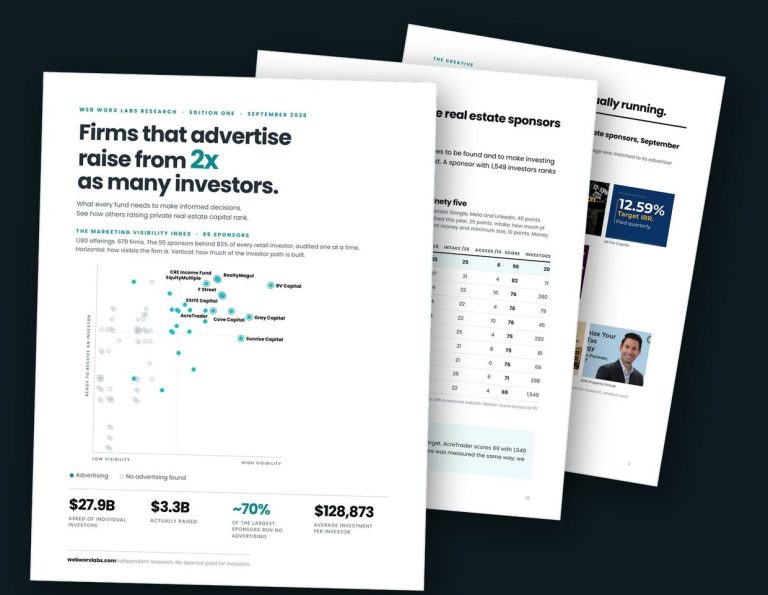 Sponsors asked investors for $27.9 billion last year. They collected $3.3 billion.1,180 real estate raises, 679 sponsors, one year of SEC filings. Seven in ten of the biggest sponsors run no advertising, and...