
 by Usman Sheikh
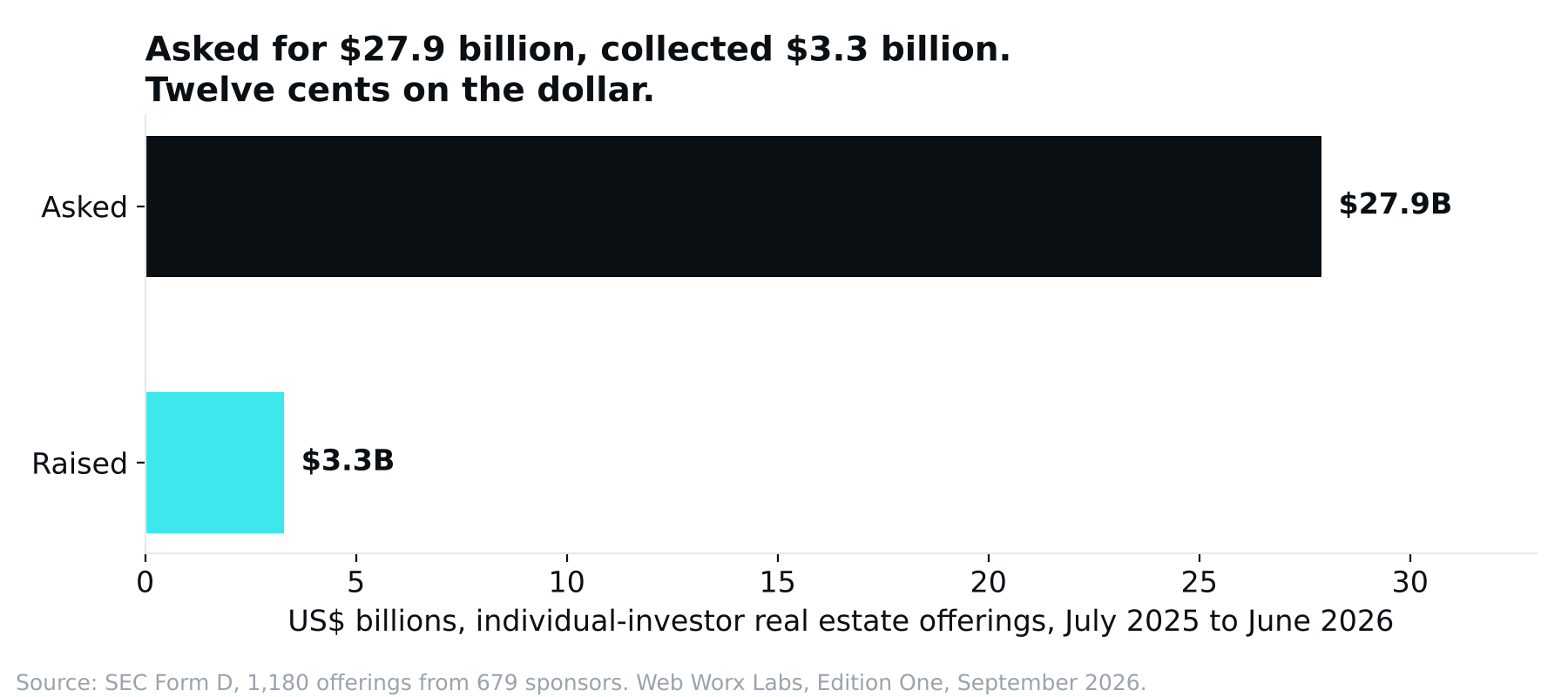
Sponsors asked investors for $27.9 billion last year. They collected $3.3 billion.
Published · Updated · By Usman Sheikh, CPA turned marketer
Last year, US real estate sponsors asked individual investors for $27.9 billion. They collected $3.3 billion. Twelve cents on the dollar. The missing 88 cents wasn’t lost on the deals. Most of it was never going to arrive, because most sponsors never put the deal in front of anyone they didn’t already know.
I spent a couple of years running investor acquisition inside a $1.7 billion private real estate manager, Canada and the US, the US side under 506(c). When I left, I wanted to know whether what we saw from inside was true of the whole market. So I pulled every Form D filed with the SEC for an individual-investor real estate offering in the twelve months to June 2026, 1,180 offerings from 679 sponsors, and then went through the 121 biggest sponsors one at a time, by hand, to see what they were actually doing to find investors.
We run this work for sponsors. See our 506(c) marketing agency for real estate sponsors.
This is what the numbers say. The full report, with all fourteen exhibits and the ten sponsors named and ranked, is free at the bottom of this page. For the rules and real ads from the top sponsors, read 506(c) Marketing: The Sponsor’s Guide.
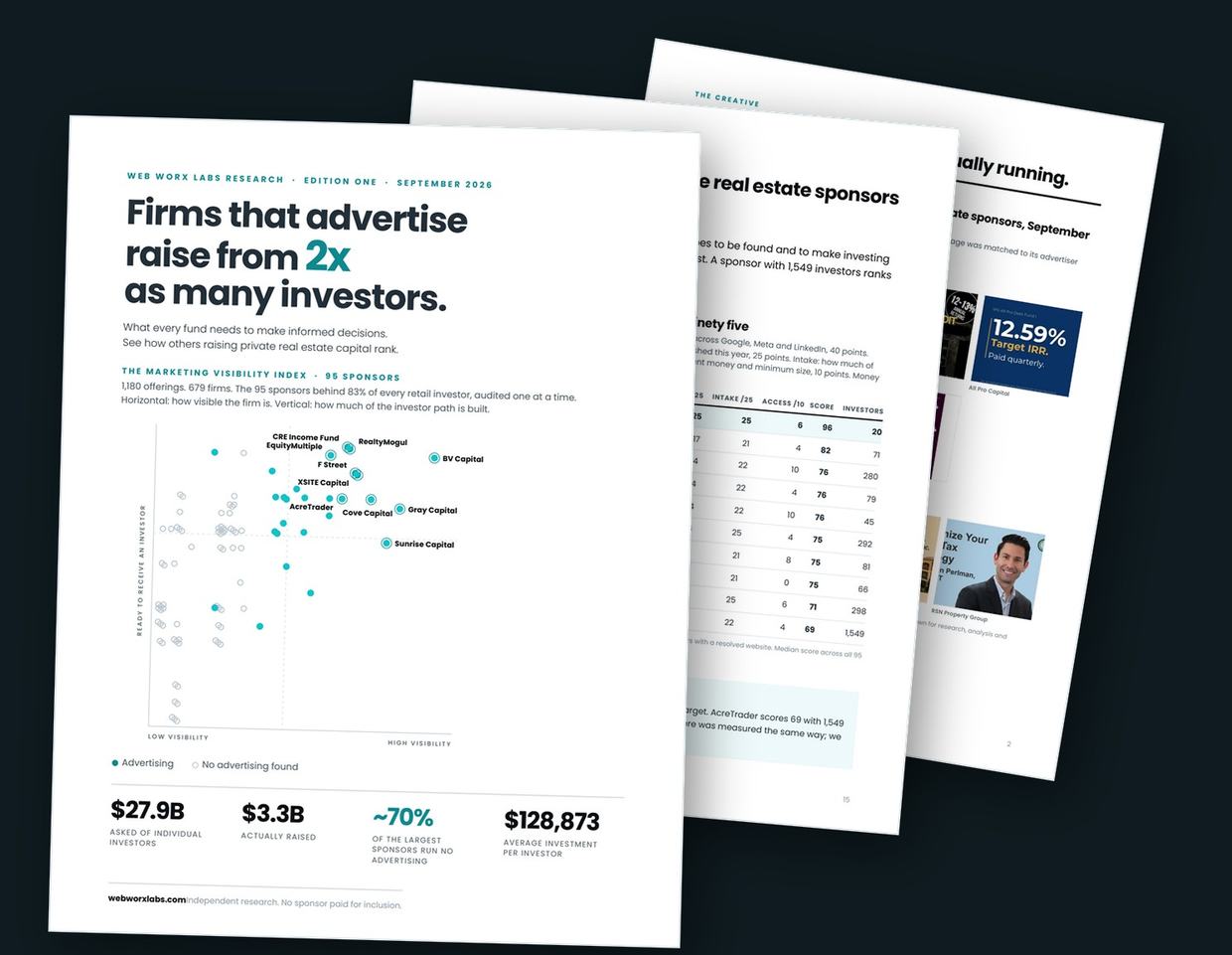
See where your firm sits against the ten most visible sponsors in the country
The full benchmark: 19 pages, 14 exhibits, 679 sponsors scored on reach, publishing, intake and access. Ten named and ranked. No sponsor paid to be in it.
The market is bigger than you think, and the average raise is smaller
Real estate is 41 percent of every firm raising from individuals under Reg D. 679 sponsors, 1,180 offerings, $27.9 billion sought. Pooled funds, financial services, technology and energy make up the rest, and some of them collect a far higher share of what they ask for. Financial services firms asked for $13.2 billion and raised $5.2 billion, 39 cents on the dollar. Real estate collected 12.
Here’s the part the conference stages skip. Among real estate offerings in that window that reported a sale, the median raised $1.9 million from 13 investors, with a stated minimum of $50,000 and an average cheque of $128,873. Thirteen investors is not a funnel. It’s a phone list. The middle of this market is a sponsor calling the people he already knows, and 55 percent of offerings report nothing raised at all. 355 of the 679 firms have brought in no investor.
Which is the first thing I’d say to anyone about to file: the question isn’t whether your deal is good. Half the deals in this market haven’t been seen by a stranger yet.
Seven in ten of the biggest sponsors run no advertising
Rule 506(c) exists so a sponsor can advertise. That’s the whole point of it: verify that your investors are accredited, and you may tell the public about your offering. So I looked at what the sponsors behind 83 percent of all retail investors were doing with that permission.
Of the 88 sponsors selling to the open market with a working website, 27 were advertising on at least one platform. 61 were not. LinkedIn was the most used platform (17 sponsors), then Google (15), then Meta (12). Fourteen of the 27 advertisers were on one platform only. Four were on all three.
Seventy percent of the largest sponsors in the country, the ones who have the money to advertise, don’t. Having run the budget on the other side of that decision, I can tell you it isn’t because they tested it and it failed. It’s because nobody on the team has done it before, compliance is nervous, and the phone list has always been enough. Until it isn’t.
What advertising actually does: same raise, twice the investors
This is the finding I’d put on the wall. Advertising does not change how much a sponsor raises. It changes how many people the sponsor raises it from.
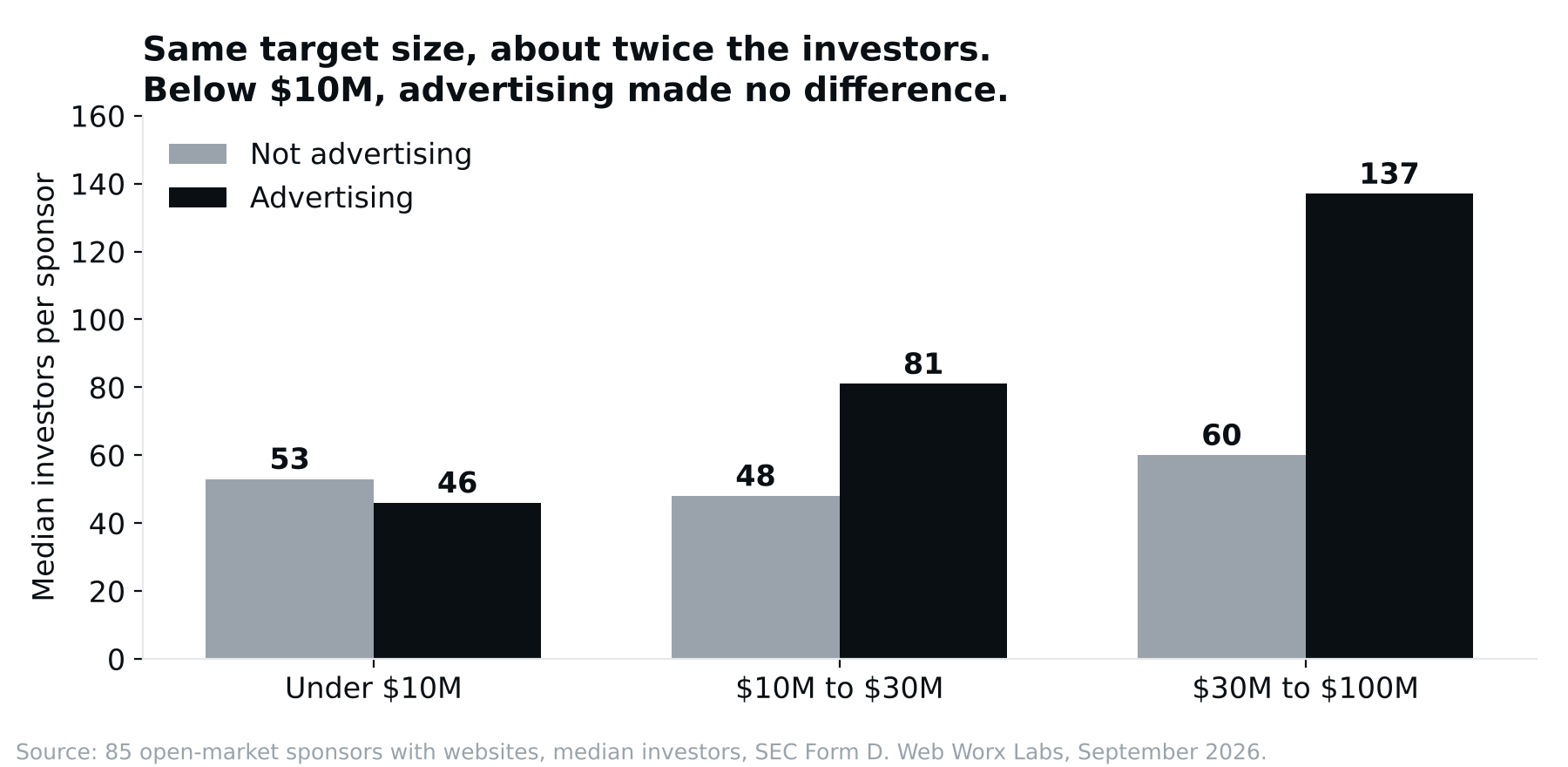
Across the 88 open-market sponsors, advertisers had a median of 81 investors and non-advertisers 54. Hold the raise size constant and the gap roughly doubles: at $10 million to $30 million, 81 investors against 48; at $30 million to $100 million, 137 against 60.
And the honest caveat, because the report is only worth something if it says the inconvenient part too: below $10 million, advertisers did no better. 46 against 53. If you’re raising $4 million for one building, the data says your phone list is as good as a campaign, and probably cheaper. The pattern shows up at $10 million and above, or from a second offering onward, when the same list has already been called twice.
Why does investor count matter if the dollars are the same? Concentration. Thirteen investors at $128,000 each is a raise that dies if two of them get divorced in the same quarter. A hundred investors is a business. Every sponsor I’ve sat across from who was on their third deal said the same thing: the first raise was friends, the second was friends of friends, and the third was the one where they ran out of friends.
How much ad budget will your raise take?
Enter your raise, average cheque and timeline. See the investors you need, the leads it takes to find them, and the budget, checked against what 1,180 real estate raises in SEC filings actually did.
Open the plannerNo email needed. Results in under a minute.At our study’s average investment of $128,873, starting with no investors from your own network. Change any number in the planner. Estimates only; real results will vary.
Advertising buys the upside. It doesn’t deliver it.
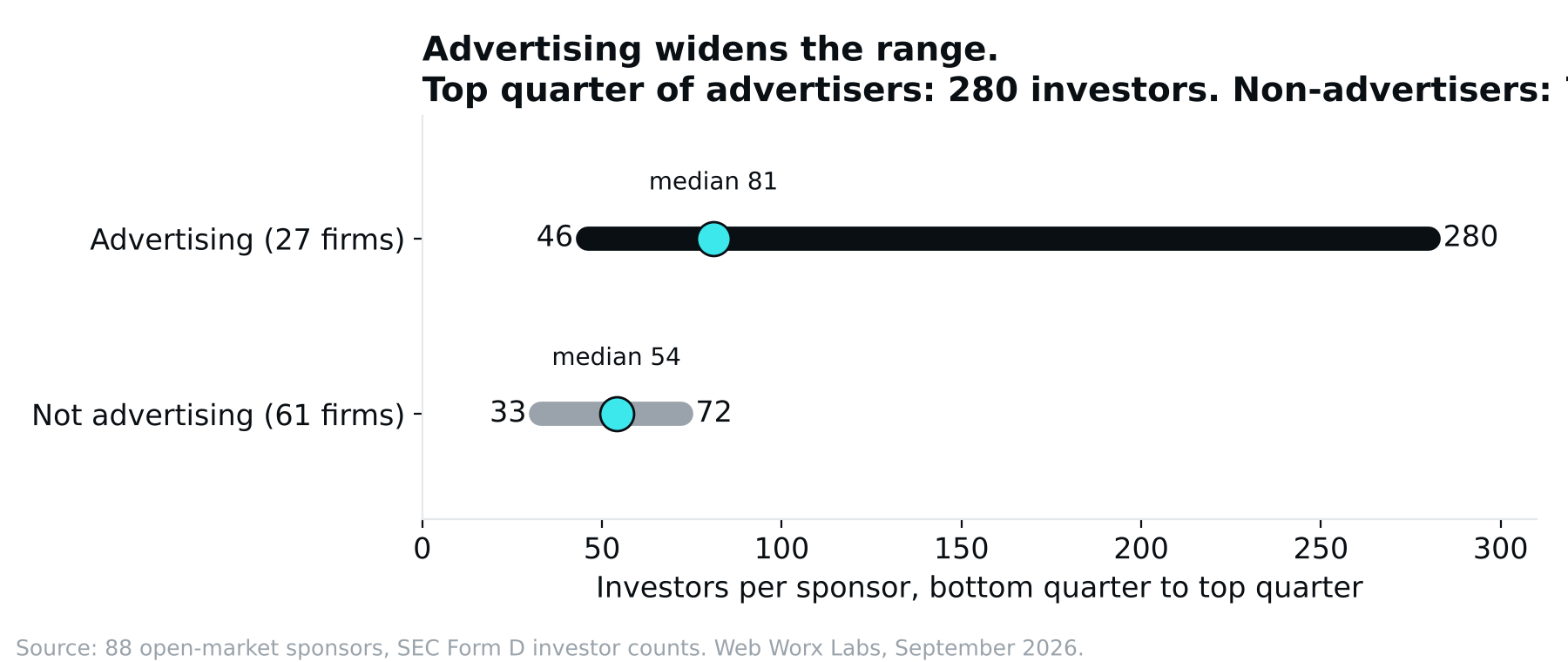
Look at the spread. Non-advertisers land between 33 and 72 investors, a tight band; you get what your network gives you, no more and no less. Advertisers run from 46 to 280. The floor is a little higher. The ceiling is four times higher. The decision to advertise opens the door to the top of that range. It doesn’t walk you through it. What walks you through it is the next section.
Reach beats volume. One sponsor ran 500 ads and got 41 investors.
Two sponsors in the audit tell the whole story between them. One self-storage sponsor had roughly 500 Google ads running when I looked, no LinkedIn presence, and two of the five intake features an investor looks for. It brought in 41 investors in twelve months. A second sponsor was running seven Google ads and five LinkedIn ads, had all five intake features built, and brought in 298.
Seventy times the ad volume. One seventh of the investors. Most of this market treats advertising as something you try, turn on for a month, and judge by whether the phone rang. The sponsors it works for treat it as a system: the ad is the smallest part, and what happens after the click is where the investor is won or lost.
This is the system we ran in-house. Paid reach, a landing page compliance had signed, an accreditation step, a webinar, and a follow-up sequence, with a compliance officer on every draft. At peak it produced 2,500 qualified investor leads a month and average deal size went up 45 percent. Book a call and I’ll tell you what I’d do with your raise.
Five things an investor looks for. Four firms in 95 have all of them.
Before an accredited investor enquires, they check five things on your site. Whether they can reach you. Whether there’s a portal, which tells them you’ve done this before. Whether there’s an accreditation gate, which tells them you’re running this properly. Whether there’s a webinar, because people hand over $100,000 to a voice, not a PDF. And whether they can invest retirement money, because for a lot of them that’s where the money is.
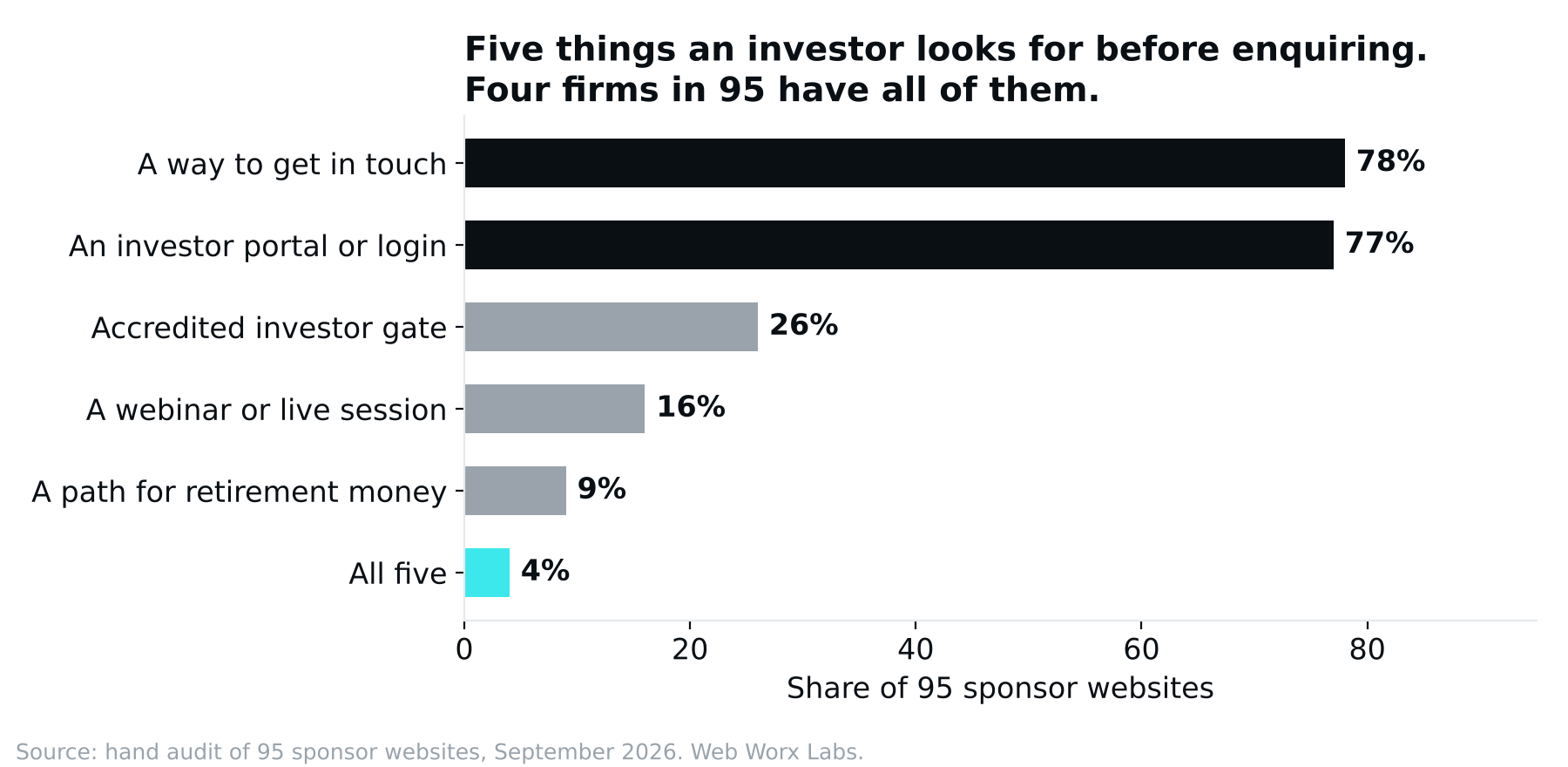
Seventy-eight percent have a contact form. Seventy-seven percent have a portal. Then it falls off a cliff: 26 percent have an accreditation gate, 16 percent run a webinar, 9 percent can take IRA money. Four sponsors out of 95 have all five.
This is the cheapest fix in the whole report. None of these cost real money. The webinar is a Zoom link. The IRA path is a conversation with a custodian. The gate is a form. A sponsor spending $20,000 a month on ads that land on a page with two of the five is paying full price for a quarter of the result.
The harder the asset is to explain, the less of the ask gets collected
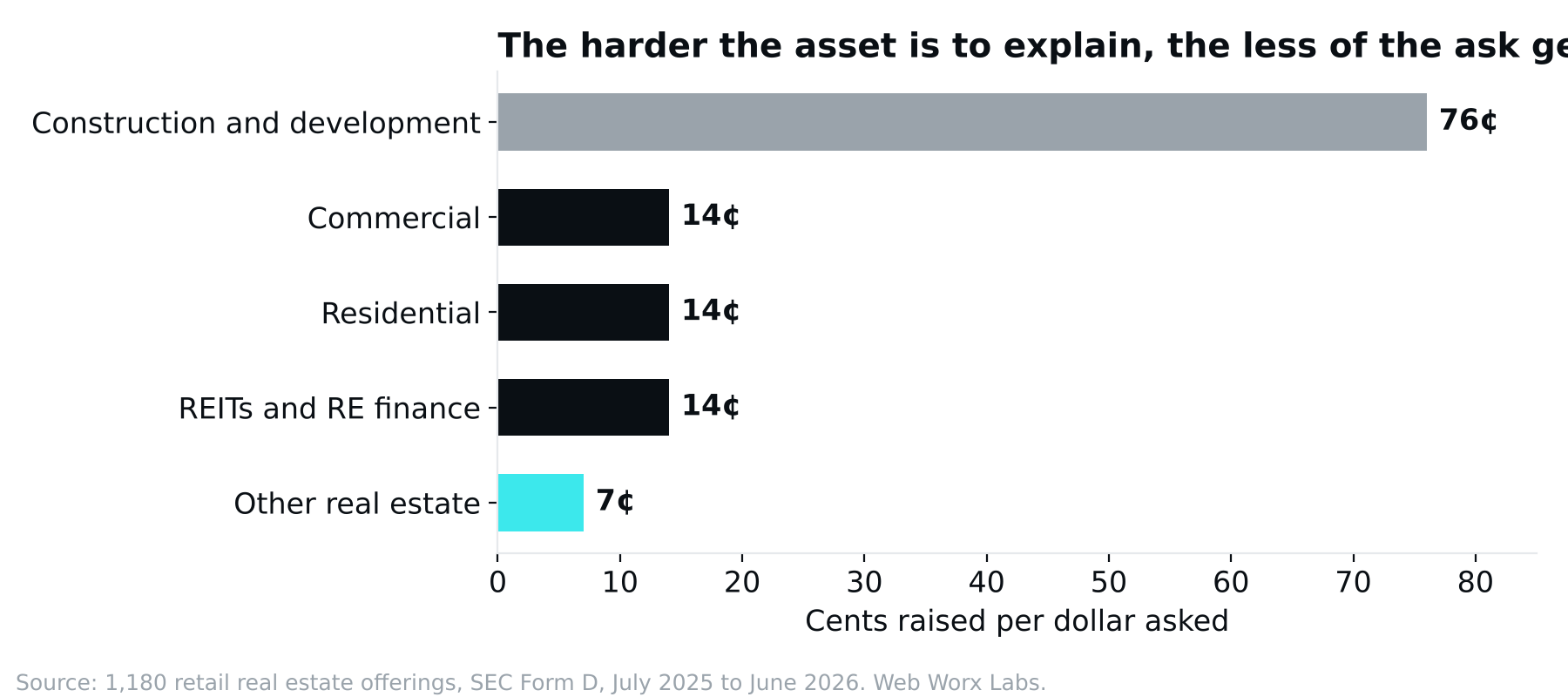
Commercial sponsors asked for $8.9 billion and collected 14 cents on the dollar. Residential, 14 cents. “Other real estate,” the bucket where the complicated structures live, asked for the most of anyone, $12.5 billion, and collected 7 cents. The ten construction and development offerings collected 76, which says something about what happens when the investor can picture the thing being built.
Residential sponsors also advertise at twice the rate of commercial ones, 42 percent against 21. The asset class an investor already understands is the one the sponsor is most willing to put in front of a stranger. That’s not a coincidence.
The ten most visible sponsors in the country, scored
I scored all 95 sponsors on four things: reach (are they advertising, and where), publishing (do they keep talking to the undecided), intake (the five features above) and access (can an investor actually get in). The median score is 35 out of 100. These are the top ten.
| Rank | Sponsor | Score /100 | Investors, 12 months | What stands out |
|---|---|---|---|---|
| 1 | BV Capital | 96 | 20 | Full marks on reach, publishing and intake. Deal-led ads with a close date and a risk footnote. Few investors yet; the system is ahead of the raise. |
| 2 | Gray Capital | 82 | 71 | Maximum reach; yield-led and brand ads. |
| 3 | CRE Income Fund | 76 | 280 | Strongest access score in the ten. Yield-led ads. |
| 4 | Cove Capital Investments | 76 | 79 | Brand ads, strong reach. |
| 5 | RealtyMogul | 76 | 45 | Full access; deal-specific ads. |
| 6 | F Street | 75 | 292 | Full intake; yield-led. Second-highest investor count among the scored. |
| 7 | XSITE Capital Investment | 75 | 81 | Founder-led ads, an investor-dinner photo, no return number in the ad. |
| 8 | Sunrise Capital Investors | 75 | 66 | Maximum reach, tax-led ads, zero on access. |
| 9 | EquityMultiple | 71 | 298 | Seven Google ads, five LinkedIn ads, all five intake features. The volume-versus-reach example. |
| 10 | AcreTrader | 69 | 1,549 | Lowest score in the ten and by far the most investors. Visibility and scale are different things. |
Two things in that table that nobody will say on a panel. The number one sponsor has 20 investors, because scoring well on visibility is a leading indicator, not a result. And the sponsor with 1,549 investors scored lowest in the ten, because once you have a list that size, you don’t need to be found. Everyone else does.
If I were raising next quarter, here’s what I’d do with this
- Decide whether you’re a $4 million raise or a $40 million one, and act like it. Under $10 million, the data says call your list and skip the ad spend. At $10 million and up, or on your second offering, the list runs out and advertising is the difference between 48 investors and 81.
- Build the five intake features before you buy a single click. Contact, portal, accreditation gate, webinar, IRA path. 96 percent of your competitors haven’t. It costs almost nothing and it’s the part of the funnel that decides whether the click becomes an investor.
- Buy reach, not volume. Seven well-placed ads on two platforms beat 500 on one. The sponsor with 298 investors wasn’t outspending anyone. He was reaching the right people and had somewhere for them to land.
- Put the deal in the ad. The top-ranked sponsor names the property, the target return, the hold, the close date and a risk line. Compliance will have opinions. In my experience the version compliance signs off outperforms the first draft anyway, and I’ve never admitted that to them.
- Keep talking to the undecided. Fifteen of the 27 advertisers go silent after the click. Twelve keep publishing. Guess which group has the 280-investor quarter.
How this was built, and what it doesn’t measure
Source: SEC Form D structured data sets, quarterly releases, joined on accession number across the submission, issuer and offering tables. Period: July 2025 to June 2026, the four most recent complete quarters. Universe: every Form D for an individual-investor real estate offering in that window, 1,180 offerings from 679 sponsors, one record per firm with the highest amount sold and highest investor count kept where a firm filed more than once. Audit: the 121 firms behind 83 percent of retail investors, reviewed one at a time in September 2026, not scraped. 95 had a working website; 88 sell to the open market (three RIAs, two EB-5 centres, one institutional-only firm and one brokerage were excluded). Statistics are medians throughout; a few very large pooled filings make the mean useless.
What it doesn’t measure: creative quality, spend, targeting, or what happens after the click. Ad counts are a point-in-time reading from one week in September. The sample is the top of the market, not every sponsor who has ever run an ad. And I should say plainly that my firm sells investor acquisition to sponsors, so read the conclusions knowing where I sit. The numbers are the SEC’s. The opinions are mine.
The full method, tables and limitations are published as a working paper on SSRN: Who Advertises Under Rule 506(c), and Does It Help? Evidence from the Form D Filings of 679 U.S. Real Estate Sponsors, 2025 to 2026 (DOI 10.2139/ssrn.7616861).
Questions sponsors ask about this
Can I advertise my offering at all? Under Rule 506(c), yes, to the public, provided every investor is accredited and you take reasonable steps to verify it. Under 506(b) you can’t. One in ten raises in the window used 506(c).
What’s a normal cost per verified accredited investor? It depends on the asset, the minimum and the landing page, which is why nobody publishes one number. What I can say from running it: the cost is set less by the ad than by what’s on the page after it. Fix the five intake features first and the cost per investor falls before you touch the media budget.
Does a marketing firm take a cut of what I raise? It can’t. A percentage of capital raised is transaction-based compensation and needs a broker-dealer licence. A marketing firm charges a fee for the work, and you keep the investor list. That’s the trade: a broker-dealer brings the investors and keeps the relationship; marketing builds you a list you own for the next deal.
Which platform works for accredited investors? In the audit, LinkedIn is the most used (19 percent of open-market sponsors), then Google (17 percent), then Meta (14 percent). The sponsors with the most investors were on two or three, not one.
I’m raising under $10 million. Should I bother? Probably not with paid media, on this data. Build the five intake features, run the webinar, and call your list. Revisit when you file the second offering.
Published research · SSRN working paper
Every number on this page is in a published working paper
The data here comes from a working paper published on SSRN, the open research library used by economists, finance researchers and law schools. It sets out the full method, every table, and what the data can and can’t show, so you can check any claim on this page against the source.
Who Advertises Under Rule 506(c), and Does It Help? Evidence from the Form D Filings of 679 U.S. Real Estate Sponsors, 2025 to 2026
Usman Sheikh, CPA · Web Worx Labs · October 2026
DOI 10.2139/ssrn.7616861 · 9 pages · Open access, CC BY 4.0
How to cite this research
Sheikh, Usman. “Who Advertises Under Rule 506(c), and Does It Help? Evidence from the Form D Filings of 679 U.S. Real Estate Sponsors, 2025 to 2026.” Working paper, SSRN, October 15, 2026. https://doi.org/10.2139/ssrn.7616861
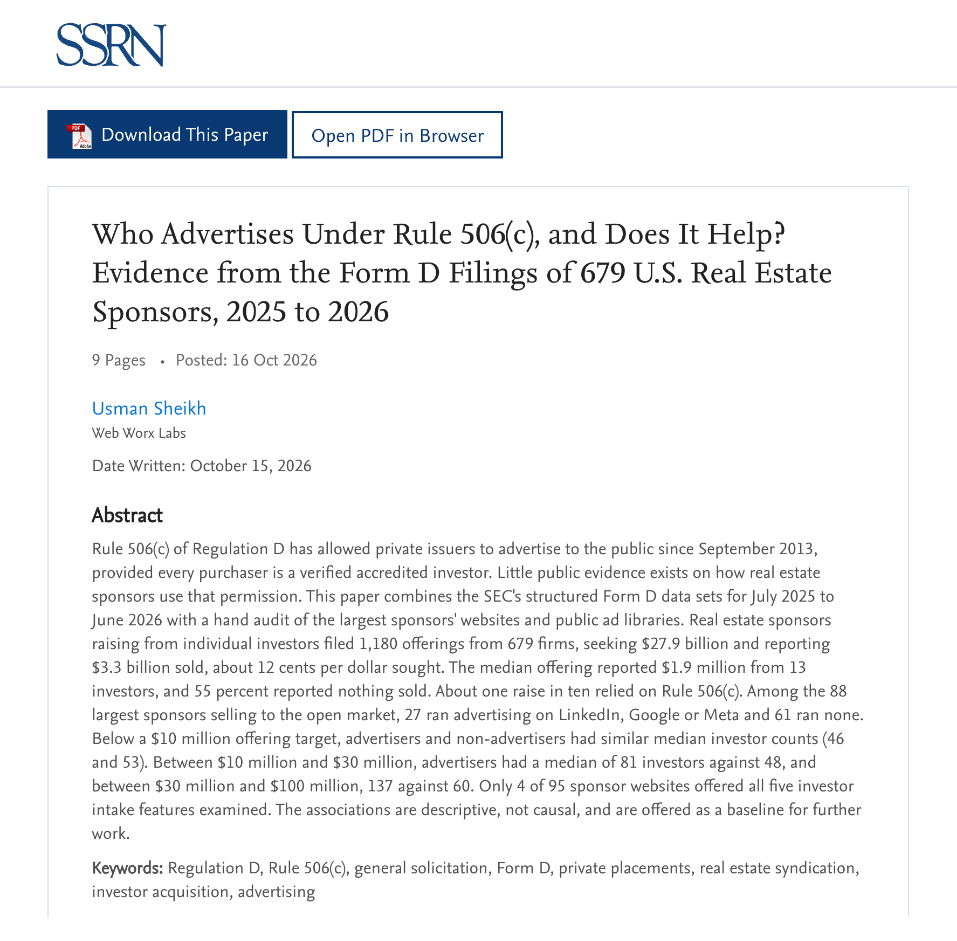
The paper’s abstract page on SSRN.
Get the full benchmark, or tell me what you’re raising
Download the free report: 19 pages, 14 exhibits, 679 sponsors, ten named and ranked. No sponsor paid for inclusion.
Read the case study: in-house at a $1.7 billion private real estate manager, 2,500 qualified investor leads a month at peak, +45 percent average deal size, a compliance officer on every draft. Names in this sector stay private; the numbers don’t.
Book a 15-minute call: tell me the raise size, the asset and the close date, and I’ll tell you where you sit against the 95 and what I’d fix first. No deck.
Tell me what you’re raising
Raise size, asset, close date. I’ll reply within one business day with where you sit against the 95 sponsors in the audit and the first thing I’d fix. No deck, no newsletter.
Share this with a sponsor who is raising.
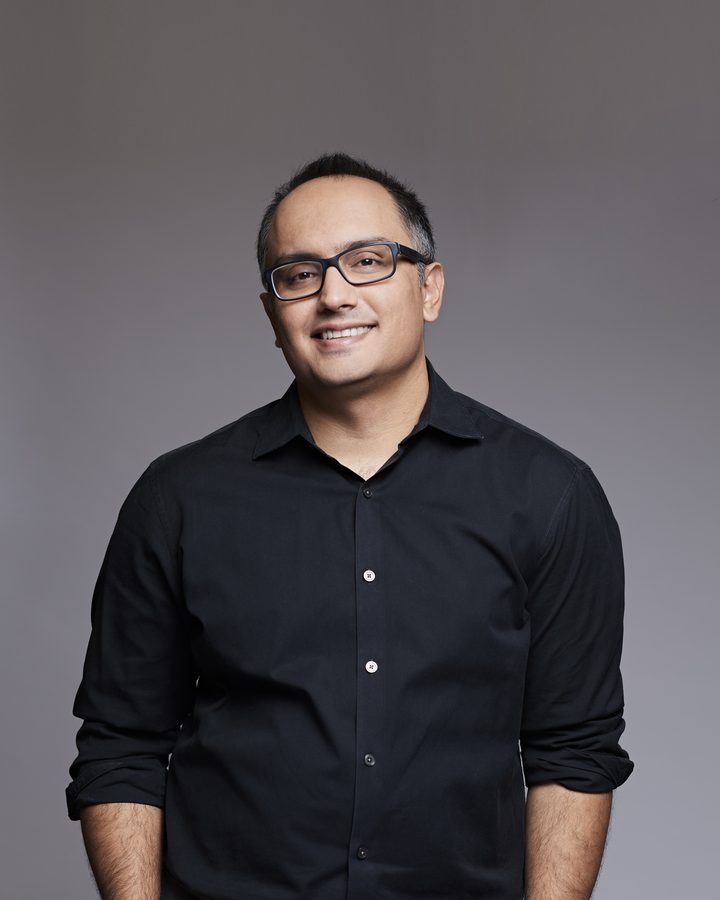
About the author
Usman Sheikh, CPA is the founder of Web Worx Labs, a growth marketing firm for regulated industries, with published case studies across private capital, insurance, mortgage and pharma. He spent a couple of years as Senior Director of Performance and Growth at a $1.7 billion private real estate investment manager operating in Canada and the US, where he ran investor acquisition across retail and wholesale channels, with the US raise under Rule 506(c) and a compliance officer reviewing every asset before it ran. At peak the program produced 2,500 qualified investor leads a month and average deal size rose 45 percent. Before that: twenty years across financial planning and analysis, agency ownership and marketing leadership in retail, energy, pharma, financial services and private equity, including time at Saudi Aramco. He holds CPA designations in Canada and the United States and is certified in Google Ads and Google Analytics.
How this research was done: the author pulled the SEC Form D structured data sets directly, joined and deduplicated the filings himself, and audited the 121 largest sponsors by hand in September 2026. Every number on this page traces to a filing or to a sponsor’s own public website. Corrections: contact us.
LinkedIn · About Web Worx Labs · The US Private Placement Benchmark, Edition One · Published October 14, 2026

Usman Sheikh, CPA, is the founder of Web Worx Labs. Qualified as a CPA in Canada and the United States, with twenty years across financial planning and analysis, agency ownership and marketing leadership. Previously Senior Director of Performance and Growth at a $1.7 billion private real estate investment manager in Canada and the US, running investor acquisition across the retail and wholesale channels. Earlier, oil and gas at Saudi Aramco, and campaigns across pharmaceutical, insurance, retail and industrial manufacturing.
Keep reading
 Real Estate Investment Website: What Investors Look ForBefore they call, they look you up.
 What It Costs to Raise $10 Million With 506(c) AdsWhat a $10 million raise really costs in ads
 Marketing a Real Estate Fund: Investors Back You, Not a BuildingIn a fund, investors back you, not a building.
 Real Estate Syndication Marketing: How Sponsors Fill a RaiseIt starts with a building you can't buy alone.
 506(b) vs 506(c): Can You Advertise Your Next Raise?One meeting with your lawyer shapes the whole raise.
 How to Raise Capital for Real Estate: A Sponsor’s Marketing PlanMost capital is raised before anyone asks.
 How to Find Investors for Real Estate SyndicationsWhere new investors come from after family and friends.
 506(c) Marketing: The Sponsor’s GuideHow sponsors market a 506(c) offering: what the rule allows, real ads from the most visible sponsors, and what 679 sponsors' SEC...