
 by Usman Sheikh
Real Estate Investment Website: What Investors Look For
Published · By Usman Sheikh, CPA turned marketer
Before an investor calls you, they look you up. It happens quietly, often the night before.
Maybe a friend mentioned your last deal over dinner. Maybe they saw your LinkedIn post about the building you just closed on, or a colleague forwarded your name with a short note: “You should talk to this person.” Before they reply, they type your name into Google and click on the first link.
What they find there sets the tone for the whole conversation. They are looking for a few simple things: who you are, what you have done, what you buy, and what happens if they raise their hand.
Most sponsors built their website around the first raise, when every investor already knew them. But the people who back your third or fourth deal are often a step or two removed from you. This guide walks through what they look for, and how to turn a quiet visit into a conversation.
Only 4 of 95 sponsor websites had all five things investors look for
In September 2026 we audited 95 US real estate sponsor websites by hand. We checked each one for five things an investor looks for before they enquire: a way to get in touch, an investor portal or login, an accredited investor gate, a webinar or live session, and a path for retirement money.
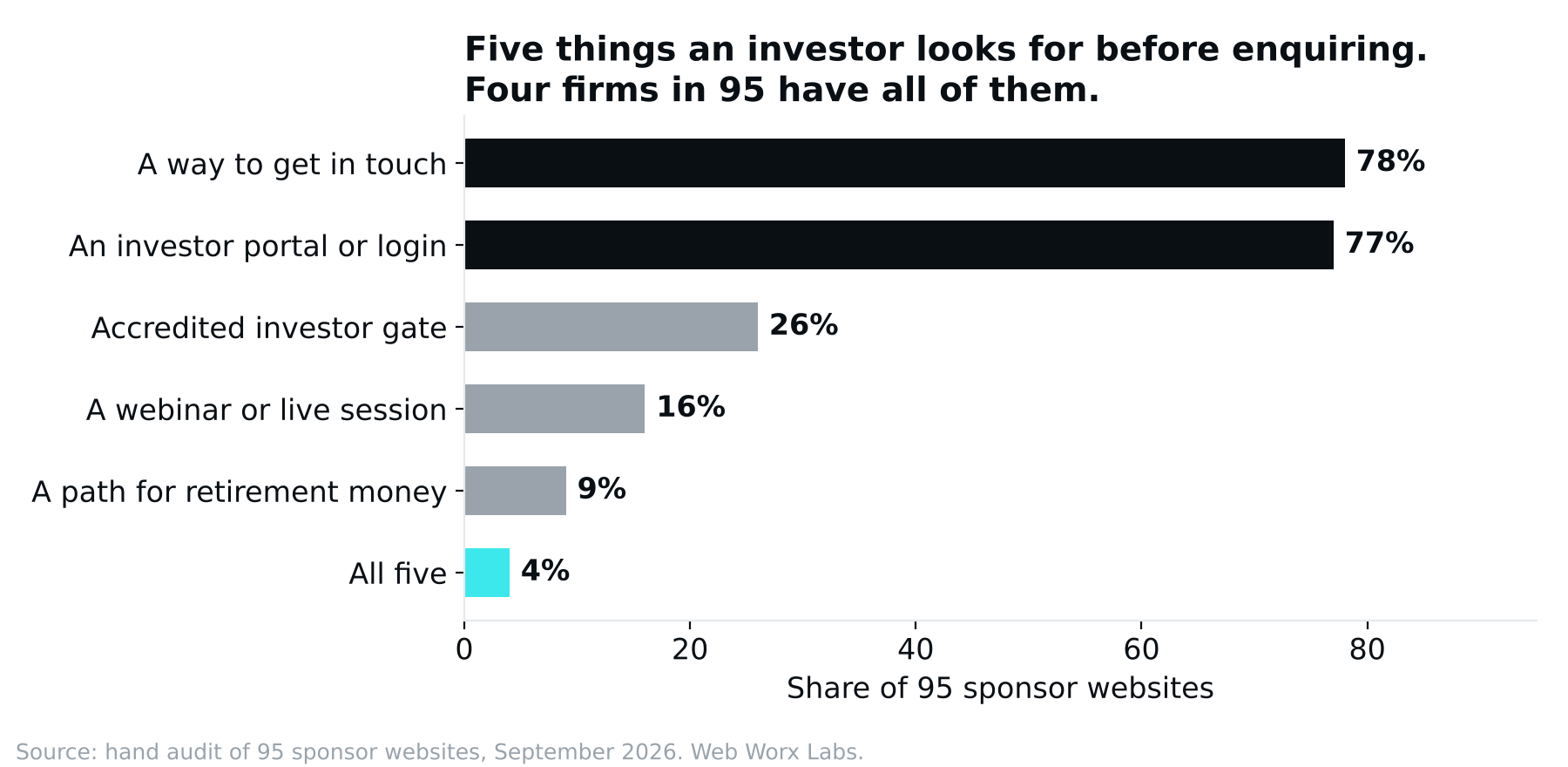
The basics were mostly there. 78% offered a way to get in touch and 77% had an investor portal or login. After that it dropped off quickly: 26% had an accredited investor gate, 16% offered a webinar or live session, and 9% showed a path for retirement money.
Only 4 of the 95 had all five. That is the part worth sitting with. Most sponsor sites are built to serve the investors who are already in, through the portal, more than to welcome the ones still deciding. The full findings sit in our 506(c) advertising study.
My take: What I’d suggest is opening your own website on your phone tonight and asking one question: if I had never met me, what would I do next on this page? If the answer is “send an email and wait”, there is room to make it easier.
Case study
Our founder built and ran this system in-house at a $1.7 billion real estate manager
Paid reach on more than one platform. A landing page compliance had signed. An accreditation step. A webinar. A follow-up sequence. The same pieces, run as one system.
Your track record is the product, so show it plainly
A visitor first wants to know who they would be trusting with their money. Put real names, real photos and a short line on each person’s background on the page.
Then show the deals you have done in a simple list. The property, the city, the year you bought it, what you did with it, and where it stands now. Include the ones still in progress, and give any deal that did not go to plan a calm, plain sentence on what happened.
Investors notice what is missing. Guides written for passive investors tell them to look at how a sponsor did in weak markets as well as strong ones, and how many past projects have actually finished. If your page only shows the wins, a careful reader will ask about the rest anyway.
If you are early, say so warmly. A first-time sponsor can show the experience behind the team: years managing properties, a background in construction or lending, the partners who have done it before. Honest and small reads better than vague and big.
Say your strategy in words a friend could repeat
The people who refer you will describe you in one sentence. Give them that sentence. For example, “We buy older apartment buildings in mid-sized cities, fix them up and hold them for several years” is something a brother-in-law can repeat at a family dinner.
Then add a few lines on why. Why that market, why that kind of building, and what your team does well. Let the investor deck carry the detail.
Give every visitor one clear next step
A way to get in touch was the most common feature in our audit, but on its own it still asks a curious visitor to write to a stranger. A visitor who is curious but not ready to talk needs something smaller to say yes to.
- Join the investor list. Name and email, plus one line on what they will receive, such as a note when a new deal opens and a short update each quarter.
- A simple intake form. Five or six questions at most: name, email, phone, the rough amount they are thinking about, how they heard about you, and whether they plan to invest from a retirement account.
- A calendar link. Let them book a short intro call at a time that suits them, instead of waiting for an email back.
Ask how they heard about you on every form. Over a raise, it shows whether commitments came from referrals, LinkedIn, the webinar or a search. Our guide on how to find investors for real estate covers those sources in more depth.
For an investor who doesn’t know you yet, your website is the first meeting.
A webinar or replay lets investors meet you before they call
Only 16% of the sites we audited offered a webinar or live session. That is a quiet missed chance, because a webinar is the closest thing to a coffee with you that more than one person can attend.
It does not need to be polished. Thirty to forty minutes on how you choose markets, run a property and look after investors, with time for questions. Put the replay on your site, so someone can watch it at ten at night after the kids are asleep.
Show real buildings, real people and a path for retirement money
Photos of your actual properties do more than any stock image. Before and after shots of a renovated unit, your team on a site walk, a building you have held for years. They show the work is real.

Make the investor portal visible, and say what is in it. Most sites had a portal or login, often as a small button in the corner. For a new visitor, a line such as “Current investors log in here for documents, distributions and updates” is quiet proof that you have investors and report to them.
Retirement money deserves its own short page. Only 9% of sites showed a path for it. The SEC’s investor site notes that self-directed IRAs can hold alternative assets such as real estate and private placements, and that the custodians who hold those accounts do not evaluate the investments. So explain plainly whether you accept that money and who on your team can walk them through it, and have counsel review the page.
Tell them what happens after they enquire, then reply the same day
Not knowing what comes next stops people. A short “What happens next” section takes that worry away. For example:
- You hear back from a real person, by name, within one business day.
- We set up a short call to learn what you are looking for.
- You receive our investor overview and a link to the latest webinar replay.
- When a new deal opens, you hear about it from us first.
Then keep that promise. Interest is warmest in the hours after someone fills in the form. A same-day reply from a named person, written for them, does more than a polished autoresponder followed by silence.

A checklist for your investor page before the next raise opens
You do not need to rebuild your site. Most of this is a few new sections on pages you already have.
Investor page checklist: ten things to have before your next raise opens
What each part does for a visitor who doesn’t know you yet, and a quick way to test it on your own site.
| What the page needs | What it does for the investor | Quick test |
|---|---|---|
| Who you are | Puts real names, faces and backgrounds to the money | Can a stranger name your team after one minute? |
| Track record | Shows past deals, including the ones still in progress | Is every deal listed with city, year and where it stands? |
| Strategy in plain words | Gives referrers one sentence to repeat | Could a friend outside real estate explain it back? |
| Join the investor list | Offers a small first step for the curious | Does it say what they will receive? |
| Simple intake form | Lets them raise their hand in under a minute | Six questions or fewer, including how they heard about you? |
| Calendar link | Lets them book a call without waiting for a reply | Can they book from their phone in three taps? |
| Webinar or replay | Lets them meet you before they call | Is the latest replay easy to find? |
| Proof | Photos of real properties and the team at work | Is every photo of your own buildings and people? |
| Path for retirement money | Answers whether they can invest from a retirement account | Does it say whether you accept it and who to call? |
| What happens next, and a fast reply | Removes doubt about the next step | Does a real person reply the same business day? |
My take: If you only have an afternoon, I’d start with the intake form, the calendar link and the “what happens next” section. They are small, and they decide whether a good visit becomes a call.
What the rules say about your website
Your website is public, so the rule your offering relies on shapes what it can show. The SEC’s page on Rule 506(b) says there can be no general solicitation or advertising to market the securities. So a 506(b) sponsor will want to ask counsel what can sit on public pages and what belongs somewhere private. Under Rule 506(c), a sponsor can advertise a live offering broadly, but every buyer must be accredited and the sponsor must take reasonable steps to verify it. Investor.gov sets out both side by side, and our 506(b) vs 506(c) guide covers the marketing side. Before a raise opens, confirm with your securities counsel what your own pages can show.
A good investor page makes the first call easier
I think of a sponsor’s website as the quiet part of the raise. It is often where a referral becomes a real conversation, or gently goes cold. If your next raise will need investors who don’t know you yet, I’d be glad to look at your site with you and talk through what would help. For the wider picture of marketing a raise, our 506(c) marketing guide is a good place to start, and the data behind this post is in our study.
Raising in the next six months?
Tell us the raise size, the asset and the close date. We’ll show you where you sit against the 95 sponsors in our audit, and the first thing we’d fix. Fifteen minutes. No deck.
Tell us what you’re raising
One team for the whole raise: the investor website, the ads, the video and design, and the follow-up that turns interest into calls. Send us the raise size, asset and close date, and we’ll reply within one business day with where you sit against the 95 sponsors in our audit.
Questions sponsors ask
What should a real estate investment website include?
Who you are, your track record, your strategy in plain words, a way to join your list, a short intake form, a calendar link and a note on what happens after someone enquires. A webinar replay, photos of your own properties and a page on retirement money make it stronger.
What is the difference between an investor website and an investor portal?
The website is for people still deciding: it tells them who you are and gives them a next step. The portal is a secure login for people who have already invested, where they see their holdings, documents and updates.
Can I show my current deal on my website?
That depends on the rule your offering relies on, which the section on the rules above touches on, and our 506(b) vs 506(c) guide covers from the marketing side. Ask your securities counsel before you publish anything about a live offering.
How quickly should I reply to a new investor enquiry?
The same business day if you can, from a named person, written for them. Tell visitors on the page when they will hear from you, then keep that promise.
More guides for sponsors
- How to find investors for real estate: where your next investors come from once friends and family are invested
- How to raise capital for real estate: the raise as a marketing plan, from the deal story to follow-up
- 506(b) vs 506(c): what each rule lets you say about your raise, and where you can say it
- Real estate syndication marketing: how sponsors fill a raise, from the investor package to the investor call
- Marketing a real estate fund: what changes when investors back you, not a building
- 506(c) marketing: how sponsors advertise: the full guide, with data from 679 sponsors’ filings
This is a marketer’s guide, not legal advice. Confirm your offering’s specifics with securities counsel.
Sources
- Sheikh, U. (2026), Who Advertises Under Rule 506(c), and Does It Help? Evidence from the Form D Filings of 679 U.S. Real Estate Sponsors, 2025 to 2026, SSRN working paper
- Web Worx Labs: The 506(c) advertising gap, study summary and hand audit of sponsor websites (September 2026)
- SEC: Private placements, Rule 506(b)
- SEC: General solicitation, Rule 506(c)
- Investor.gov: Rule 506 of Regulation D
- Investor.gov: Investor Alert, Self-Directed IRAs and the Risk of Fraud
- Realized: Sponsor evaluation for passive investors, track records, teams and process controls
- Agora: Investor portal best practices

Usman Sheikh, CPA, is the founder of Web Worx Labs. Qualified as a CPA in Canada and the United States, with twenty years across financial planning and analysis, agency ownership and marketing leadership. Previously Senior Director of Performance and Growth at a $1.7 billion private real estate investment manager in Canada and the US, running investor acquisition across the retail and wholesale channels. Earlier, oil and gas at Saudi Aramco, and campaigns across pharmaceutical, insurance, retail and industrial manufacturing.

About the author
Usman Sheikh, CPA turned marketer
Founder of Web Worx Labs. Twenty years across financial planning and analysis, agency ownership and marketing leadership in retail, manufacturing, energy, pharma, financial services and private equity, including time at Saudi Aramco and as Senior Director of Performance and Growth at a $1.7 billion private real estate investment manager in Canada and the US. CPA in Canada and the United States.
Keep reading
 What It Costs to Raise $10 Million With 506(c) AdsWhat a $10 million raise really costs in ads
 Marketing a Real Estate Fund: Investors Back You, Not a BuildingIn a fund, investors back you, not a building.
 Real Estate Syndication Marketing: How Sponsors Fill a RaiseIt starts with a building you can't buy alone.
 506(b) vs 506(c): Can You Advertise Your Next Raise?One meeting with your lawyer shapes the whole raise.
 How to Raise Capital for Real Estate: A Sponsor’s Marketing PlanMost capital is raised before anyone asks.
 How to Find Investors for Real Estate SyndicationsWhere new investors come from after family and friends.
 506(c) Marketing: The Sponsor’s GuideHow sponsors market a 506(c) offering: what the rule allows, real ads from the most visible sponsors, and what 679 sponsors' SEC...
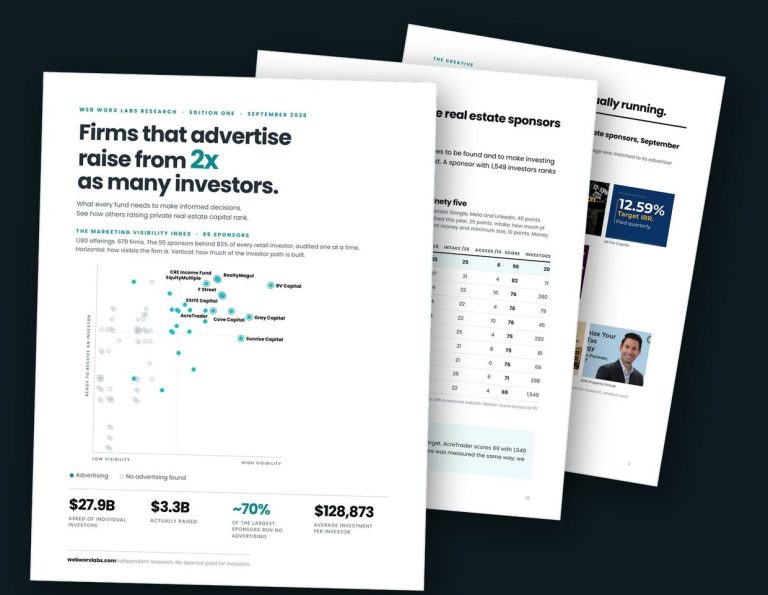 Sponsors asked investors for $27.9 billion last year. They collected $3.3 billion.1,180 real estate raises, 679 sponsors, one year of SEC filings. Seven in ten of the biggest sponsors run no advertising, and...