
 by Usman Sheikh
How to Raise Capital for Real Estate: A Sponsor’s Marketing Plan
Published · By Usman Sheikh, CPA turned marketer
Most capital is raised long before anyone asks for it. It is raised over coffee with a former colleague who asks how your last building is doing. In the update your investors forward to a friend. At the dinner where your brother-in-law tells someone what you do.
Then one day the building goes under contract, and the clock starts. You have a closing date, a lender waiting on your equity, and a number to fill. You open your phone and start going down the list.
For sponsors ready to advertise under 506(c), here is how our 506(c) marketing agency works.
The people who say yes quickly are rarely the ones you are meeting for the first time. They are the ones who have heard from you for a year, who know how you think about a deal, and who trust that you will tell them the truth when something goes wrong.
That is good news, because it means a raise can be planned. This guide walks through raising capital for real estate as a marketing plan, from the sponsor’s side: who you raise from, what you send, the investor call, the follow-up, and the timing.
Capital comes from five circles, and each one needs something different from you
Every dollar in your raise will come through one of five routes. They differ in how well the investor knows you and how much work they take.
- Your own circle. Family, close friends, past colleagues and your last deal’s investors. They back you more than the building, so what they need most is honesty about the risk.
- Referrals. The people your investors, accountant, lawyer and lender mention you to. A short, specific ask after a good update works better than “let me know if anyone is interested.”
- Your own list. People who joined your email list, came to a call or read what you write. They chose to hear from you, and this circle grows between deals.
- Platforms. Sites that list sponsor deals for their accredited members, usually for a fee. Before you list, ask who owns the investor relationship after the raise.
- Placement through a broker-dealer. A registered broker-dealer can place your offering with its clients for a fee. It suits larger raises, and the relationship is shared with the firm.
Where capital comes from, and what each source asks of you
The five circles side by side, to help you decide where to spend time before the next raise.
| Source | How well they know you | What it takes from you | Who owns the relationship after | Best used for |
|---|---|---|---|---|
| Your own circle | Very well | Honest conversations, one at a time | You | The first commitments that give the raise momentum |
| Referrals | Through someone they trust | A clear ask and a good reason to share | You | Growing past your circle without ads |
| Your own list | From your emails, calls and posts | Steady content and follow-up between deals | You | Filling the middle of the raise, deal after deal |
| Platforms | Not at all at first | A listing fee and the platform’s process | Often shared with the platform | Reaching investors you could not reach alone |
| Broker-dealer placement | Through their adviser | A placement fee and due diligence | Shared with the firm | Larger raises that need distribution |
My take: Your circle will always start the raise, and it should. What I’d suggest is giving your list the same care, because it keeps growing while you are busy running buildings. Our guide to finding investors for real estate goes deeper on each source.
More than half of offerings reported nothing sold, so the raise is often the hard part
We read a year of SEC Form D filings from US real estate sponsors, July 2025 to June 2026. These short public notices show how much each raise sought and sold.
In 55% of the offerings we read, the sponsor reported nothing sold. Some may simply have been early when the form was filed. But the pattern is hard to miss: many sponsors can find the building and still struggle to fill the raise.
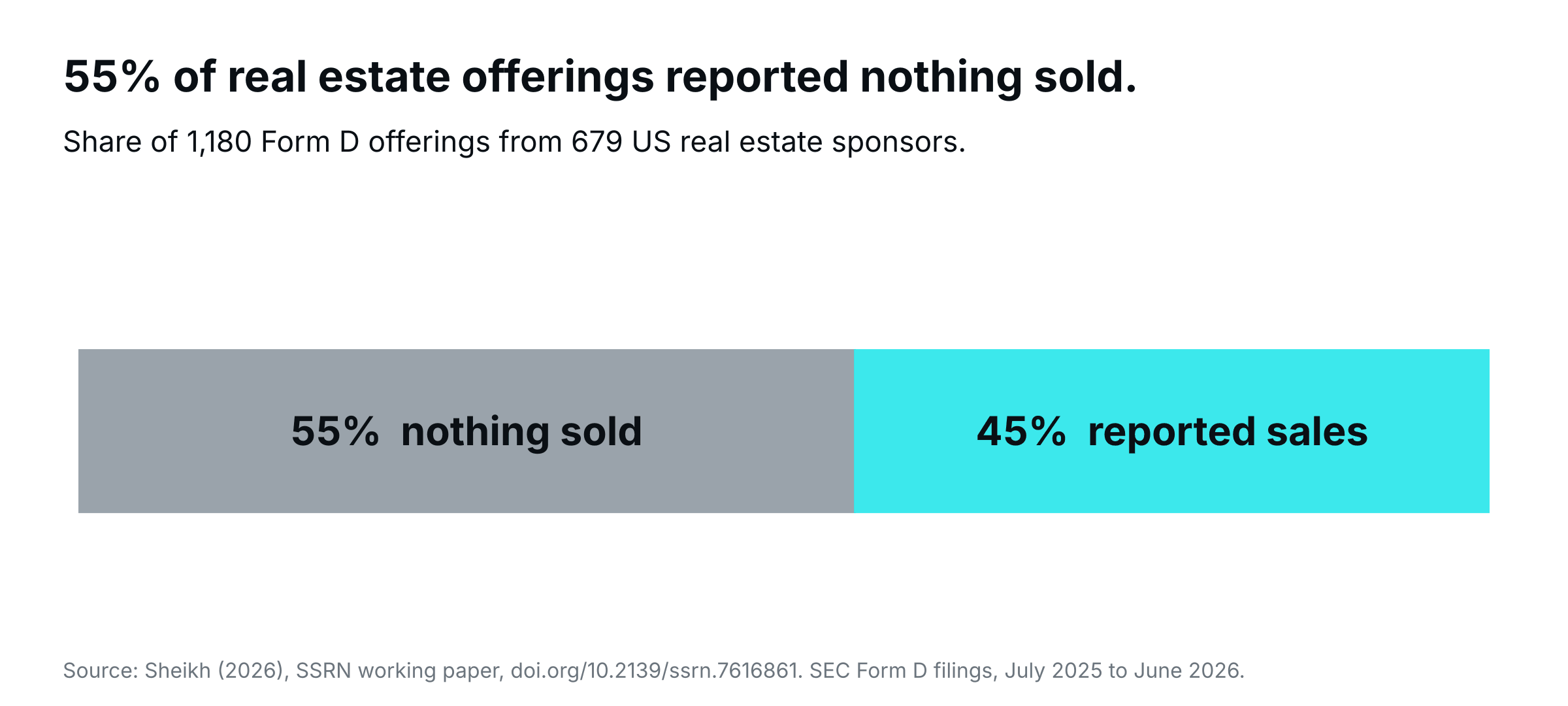
So the raise deserves its own plan. The full method is in our study of the 506(c) advertising gap.
Finding the building is one skill. Filling the raise behind it is another.
Case study
Our founder built and ran this system in-house at a $1.7 billion real estate manager
Paid reach on more than one platform. A landing page compliance had signed. An accreditation step. A webinar. A follow-up sequence. The same pieces, run as one system.
The story of the deal should fit in one paragraph
Before you build a deck, write the deal down in five plain sentences. Investors remember the deals they can repeat to their spouse that evening.
- Why this building. What you saw in it that others missed, in words a non-specialist can follow.
- Why now. What is happening in this market or with this property that makes the timing right.
- What you will do. The plan for the next few years: renovate, lease up, refinance, hold, sell.
- What the investor gets. How and when they are paid, in the plainest terms your documents allow.
- What could go wrong. The one or two risks you worry about, and what you will do about them. Naming the risk yourself makes the rest easier to believe.
Your track record is part of the story, not a separate slide. If this is your third building, say how the first two went. If it is your first, say who on your team has done this before.
The deck, the one-page summary and the landing page each do one job
One big deck sent to everyone asks too much too early. Three pieces, each sized for a different moment, work better.
- The one-page summary. The deal story, key terms, a property photo and the next step. This is what gets forwarded, so write it for a stranger.
- The deck. For someone seriously interested: market, property, business plan, team, track record, projections and risks, consistent with your offering documents.
- The landing page. One page to visit after a referral, email or call: who you are, what you invest in, and how to raise a hand. Our guide to the real estate investment website covers what investors look for before they enquire.

The intake form on that page is where the raise really starts. Ask only what helps the next conversation:
- Name, email and phone number.
- The amount they usually invest in a deal, as a range.
- When they expect to invest next.
- How they heard about you, so you know which source works.
- Their consent to be contacted by phone or text.
Then say what happens next. “We’ll email you within one business day to book a short call” reassures far more than “Thank you.”
An investor call or webinar turns interest into a real conversation
Most people want more than a deck before they commit. They want to hear you explain the deal and watch how you answer a hard question.
A group call works well for the middle of the list. Walk through the deal story in about fifteen minutes, leave the rest for questions, and send the recording the same day. Who you can invite depends on how your offering is set up, as the rules section below explains.
One-on-one calls are for the people closest to a decision. Past investors, larger cheques and anyone with a specific question. Note what each person cares about for your follow-up.
Follow-up is where soft interest becomes a commitment
Many interested investors don’t say no. They just go quiet. They meant to read the deck, then work got busy. A steady, kind rhythm brings them back without pressure:
- The same day: a thank you, with the one-page summary or the replay.
- A few days later: answer their question, or share a photo from the site visit.
- Each week of the raise: a short update on what is committed, what has happened at the property, and the closing date.
- Near the close: a personal note to each interested person on how much room is left.
- After the close: thank everyone, including those who passed, and invite them to stay on your list.
Plan the raise forward from the day you sign the contract
A purchase contract gives you a closing date, and your equity has to be in before it. Planning in phases keeps the raise from collapsing into the last two weeks.
- Before you have a deal: build the list, send a regular update, and host an occasional call about your market. It makes everything after it easier.
- When the building goes under contract: write the deal story, the one-page summary, the deck and the landing page. Bring securities counsel in now, so the documents and the marketing match.
- The first stretch of the raise: go to your circle and past investors first. Early commitments let you say, honestly, that the raise is moving.
- The middle of the raise: open it to your list and referrals. Host the group call, send the replay, and start the weekly update.
- The final stretch: personal notes to everyone still deciding, and a clear date when the raise closes.
My take: If the raise always feels rushed, the fix is usually in phase one, not phase five. What I’d suggest is giving the months between deals a small, steady rhythm, so you never start a raise from a cold list.
How much ad budget will your raise take?
Enter your raise, average cheque and timeline. See the investors you need, the leads it takes to find them, and the budget, checked against what 1,180 real estate raises in SEC filings actually did.
Open the plannerNo email needed. Results in under a minute.At our study’s average investment of $128,873, starting with no investors from your own network. Change any number in the planner. Estimates only; real results will vary.
Track where every commitment came from, so the next raise is easier
Know where the money came from, not just the total. Keep one row per investor in a spreadsheet or CRM:
- Source: circle, referral (from whom), list, platform or broker-dealer.
- Dates: first contact, first call, commitment.
- Amount: what they hinted at and what they committed.
- Cost: any fees or ad spend to reach them.
Two numbers tell you most of what you need. Cost per investor conversation shows what each source costs to book a real call. The share of calls that became commitments shows which sources bring people who are ready. Back the sources that do well on both.

What the rules say about marketing your raise
Under Rule 506(b), you cannot use general solicitation or advertising to market the offering. In practice, the deal goes to people you, or your broker-dealer, already have a relationship with, and you can still share general, educational content about your market in public.
Under Rule 506(c), you can advertise the offering openly, including ads, public posts and webinars. In exchange, every investor must be accredited, and you must take reasonable steps to verify that.
People paid a commission to bring in investors may need to be registered brokers; ask counsel. The SEC’s plain guides to raising capital and Rule 506 are good background, and our 506(b) vs 506(c) guide covers what each lets you say. Confirm your offering’s specifics with your securities counsel.
Your next raise starts well before the next building
Everything in this guide comes back to one idea: start before you need to. A list, steady updates and an easy way to raise a hand turn the raise into a next step rather than a scramble. If your next building is on the horizon, I’d be glad to hear about it and talk through who you plan to raise from. Our 506(c) marketing guide and our advertising study are good places to start.
Raising in the next six months?
Tell us the raise size, the asset and the close date. We’ll show you where you sit against the 95 sponsors in our audit, and the first thing we’d fix. Fifteen minutes. No deck.
Tell us what you’re raising
One team for the whole raise: the investor website, the ads, the video and design, and the follow-up that turns interest into calls. Send us the raise size, asset and close date, and we’ll reply within one business day with where you sit against the 95 sponsors in our audit.
Questions sponsors ask
How do I raise capital for my first real estate deal?
Start with the people who already know and trust you: family, close friends and past colleagues. Tell the deal story plainly, be honest about the risks, and ask for one or two introductions. Start an email list at the same time, so your second raise has more to draw from.
How long does it take to raise capital for a real estate deal?
It depends on your list, the size of the raise and the time the contract gives you before closing. Sponsors who stay in touch with investors between deals can usually move faster, because they are not introducing themselves for the first time.
Can I advertise my real estate raise online?
Only if the offering relies on Rule 506(c), where every investor must be accredited and verified. Under Rule 506(b), keep public content general and offer the deal to people you already know. Confirm with securities counsel before publishing anything about a live deal.
How do I raise private capital without a big network?
Build one place investors can find you, such as a simple landing page, and give people a reason to join your list with useful updates about your market. Over time, that list becomes a circle you can raise from.
More guides for sponsors
- How to find investors for real estate: where your next investors come from once friends and family are invested
- 506(b) vs 506(c): what each rule lets you say about your raise, and where you can say it
- Real estate syndication marketing: how sponsors fill a raise, from the investor package to the investor call
- Marketing a real estate fund: what changes when investors back you, not a building
- What investors look for on a real estate investment website: what our audit of 95 sponsor websites found
- 506(c) marketing: how sponsors advertise: the full guide, with data from 679 sponsors’ filings
This is a marketer’s guide, not legal advice. Confirm your offering’s specifics with securities counsel.
Sources
- Sheikh, U. (2026). Who Advertises Under Rule 506(c), and Does It Help? Evidence from the Form D Filings of 679 U.S. Real Estate Sponsors, 2025 to 2026. SSRN.
- Web Worx Labs. The 506(c) advertising gap (plain summary of the study).
- U.S. Securities and Exchange Commission. SmallBiz Essentials: What pathways are available to raise capital from investors?
- Investor.gov. Rule 506 of Regulation D.
- U.S. Securities and Exchange Commission. Guide to Broker-Dealer Registration.

Usman Sheikh, CPA, is the founder of Web Worx Labs. Qualified as a CPA in Canada and the United States, with twenty years across financial planning and analysis, agency ownership and marketing leadership. Previously Senior Director of Performance and Growth at a $1.7 billion private real estate investment manager in Canada and the US, running investor acquisition across the retail and wholesale channels. Earlier, oil and gas at Saudi Aramco, and campaigns across pharmaceutical, insurance, retail and industrial manufacturing.

About the author
Usman Sheikh, CPA turned marketer
Founder of Web Worx Labs. Twenty years across financial planning and analysis, agency ownership and marketing leadership in retail, manufacturing, energy, pharma, financial services and private equity, including time at Saudi Aramco and as Senior Director of Performance and Growth at a $1.7 billion private real estate investment manager in Canada and the US. CPA in Canada and the United States.
Keep reading
 Real Estate Investment Website: What Investors Look ForBefore they call, they look you up.
 What It Costs to Raise $10 Million With 506(c) AdsWhat a $10 million raise really costs in ads
 Marketing a Real Estate Fund: Investors Back You, Not a BuildingIn a fund, investors back you, not a building.
 Real Estate Syndication Marketing: How Sponsors Fill a RaiseIt starts with a building you can't buy alone.
 506(b) vs 506(c): Can You Advertise Your Next Raise?One meeting with your lawyer shapes the whole raise.
 How to Find Investors for Real Estate SyndicationsWhere new investors come from after family and friends.
 506(c) Marketing: The Sponsor’s GuideHow sponsors market a 506(c) offering: what the rule allows, real ads from the most visible sponsors, and what 679 sponsors' SEC...
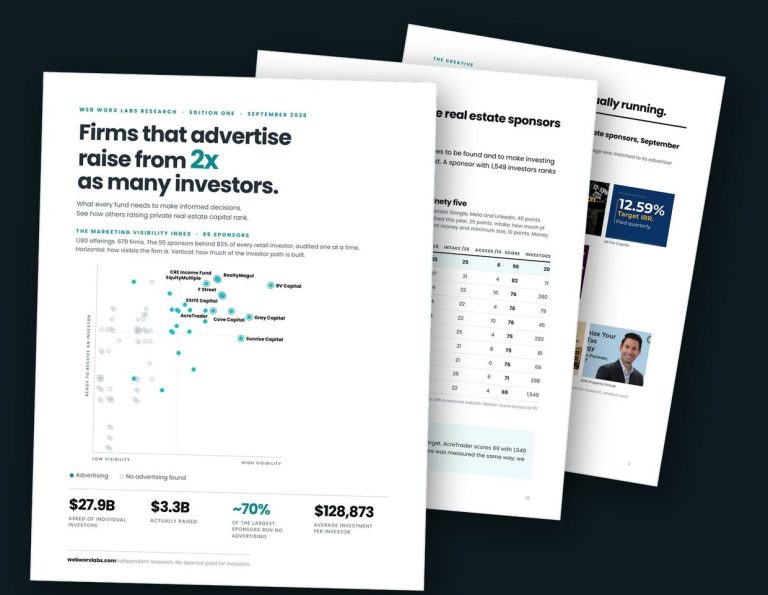 Sponsors asked investors for $27.9 billion last year. They collected $3.3 billion.1,180 real estate raises, 679 sponsors, one year of SEC filings. Seven in ten of the biggest sponsors run no advertising, and...