
 by Usman Sheikh
Real Estate Syndication Marketing: How Sponsors Fill a Raise
Published · By Usman Sheikh, CPA turned marketer
Every syndication starts the same way: someone finds a building worth buying and can’t buy it alone. Maybe it’s an older apartment building a broker sent over, or an owner you’ve been talking to for a year who is finally ready to sell. The numbers work. What you don’t have is all of the equity.
So you call the people who already trust you. A brother, a friend from work, someone who backed your last deal. They ask fair questions, and they say yes because they know you.
For syndications raising under 506(c), see how our 506(c) marketing agency finds accredited investors.
Then the buildings get bigger. The next deal needs more equity than your circle can give, and now there is a closing date, a lender waiting on proof of funds, and a few people who said “send me the deck” and went quiet. That’s usually when a sponsor realizes the building was the easier part.
Your investors are looking at the same deal from the other side. They want to know who gets paid first, what you earn, and what happens if the plan slips. This guide covers the basics of how a syndication works, then spends most of its time on the part that fills it: how you tell the deal, what you send, how you run the call, and how you keep investors close for the next one.
A syndication is one building, one entity and two kinds of owners
The sponsor forms a new entity for the deal. It is usually an LLC or a limited partnership that will own the property. The sponsor is the general partner (GP) or manager, and passive investors come in as limited partners (LPs) or members whose risk is limited to the money they put in.
The GP does the work. It finds the property, arranges the loan, raises the equity and runs the plan. LPs supply most of the equity and have little say in daily decisions.
A multifamily syndication is the most familiar version. A sponsor buys an apartment building, renovates units, raises rents toward market and sells or refinances after a few years.

One simple waterfall shows investors where each dollar goes
A waterfall pays money out in tiers. A common order is: investors get their capital back, then a preferred return, then the rest is split. The sponsor’s share of that split is the promote.
Here is a round-number illustration, not a market standard. A deal has $4 million of equity, an 8% simple preferred return and an 80/20 split. The building sells in year 5 and $6.4 million comes back to the equity. Investors get their $4 million first, then $1.6 million of preferred return (8% a year for 5 years). That leaves $800,000, split $640,000 to investors and $160,000 to the sponsor. If the sale had brought back only $5.2 million, the sponsor’s promote would be zero.
Real deals add more steps, and your operating agreement sets the actual terms. For marketing, the point is simpler: investors relax when they can see they get paid before you do.
My take: What I’d suggest is putting a simple version of this in your deck, with your own deal’s numbers. It saves you explaining it from scratch on every call.
Investors back a story before they read the spreadsheet
Most investors will not rebuild your model. They remember a few plain sentences and repeat them to a spouse or an accountant before they commit.
A good deal story answers five questions in order:
- Why this building? What is wrong with it today, or what is it missing, that you can fix.
- Why this market? Jobs, population, new supply, rents. Two or three facts, with sources.
- Why now? The seller’s situation, the price, the loan you can get.
- What will you do? The business plan in a few steps: units renovated, rents moved, costs cut, timeline.
- Why you? Your track record, your team, your property manager and how much of your own money is in.
Then say what could go wrong. Higher rates at refinance, a slower lease-up, a renovation that runs over. Naming the risks first, with a plan for each, builds trust.
Investors repeat your story to the people they trust. Write it so they can.
The investor package does the explaining when you are not in the room
Each piece answers a different question. Keep the numbers identical across all of them.
Seven pieces of a syndication investor package, and the question each one answers
Build these before you announce the deal. Have counsel review anything that describes the offering.
| Piece | What it is | The investor’s question it answers |
|---|---|---|
| One-page summary | Asset, market, plan, hold, minimum, key dates | Is this worth 30 minutes of my time? |
| Deck | The deal story, the numbers, the waterfall, the team, the risks | Do I understand what I am buying and who runs it? |
| Track record page | Past deals with what was projected and what actually happened | Has this sponsor done what they said before? |
| Investor FAQ | Fees, distributions, taxes, liquidity, reporting | What happens to my money, and when? |
| Webinar or call recording | The sponsor walking through the deal and taking questions | Do I trust the people behind it? |
| Property photos and video | The real building, street and units | Is this a real place I can picture? |
| Next steps page | How to commit, documents, funding dates, contact | How do I actually invest if I want to? |
Your first email should be short enough to read on a phone
Send it in waves, starting with the people closest to you. Past investors first, because they already know how you work. Then friends and contacts who have asked about your deals, then your wider list.
Keep the email to what makes someone want the call. One line on the building, one line on the plan, the minimum investment, the call or webinar date, and a link to book or register. Attach the one-page summary, not the whole package.
Follow up personally with people who opened but did not reply. A short note a few days later often does more than a second blast to the whole list.
The investor call is where trust gets built
Run it the same way every time. Who you are, the deal story, the numbers and waterfall, the risks, then plenty of time for questions.
Record it if you can. A replay lets people who missed it watch at night and share it with a spouse. Send it the same day with the one-page summary.
Follow up with each person within a day. People who asked a question are telling you they are interested, and a personal reply is often what turns interest into a commitment.

Answer the questions investors are told to ask
The SEC’s investor bulletin on private placements gives investors a short list to check. Careful investors bring it to your call.
- Is there a Form D? The bulletin tells investors a missing filing may be a red flag.
- Are the financial statements independently audited?
- Can I get my money out? Private placements are highly illiquid, and investors are told to be ready to hold indefinitely. Be clear about the planned hold.
- Does the sponsor answer questions well? The bulletin tells investors to treat poor answers as a warning.
Then answer the questions every sponsor hears. How much of your own money is in. What fees you earn either way. What happens if rates are higher when the loan comes due. Who on your team has done this before.
My take: I’d treat these questions as your investor FAQ. If your deck and your first email already answer them, the people who get on a call with you are the ones ready to talk about the deal itself.
Sponsors sought far more than they reported sold
We read a year of Form D filings to see what raising looks like in practice. Across 1,180 real estate offerings filed between July 2025 and June 2026, sponsors sought $27.9 billion and reported $3.3 billion sold. For many sponsors, the raise, not the deal, is the hard part.
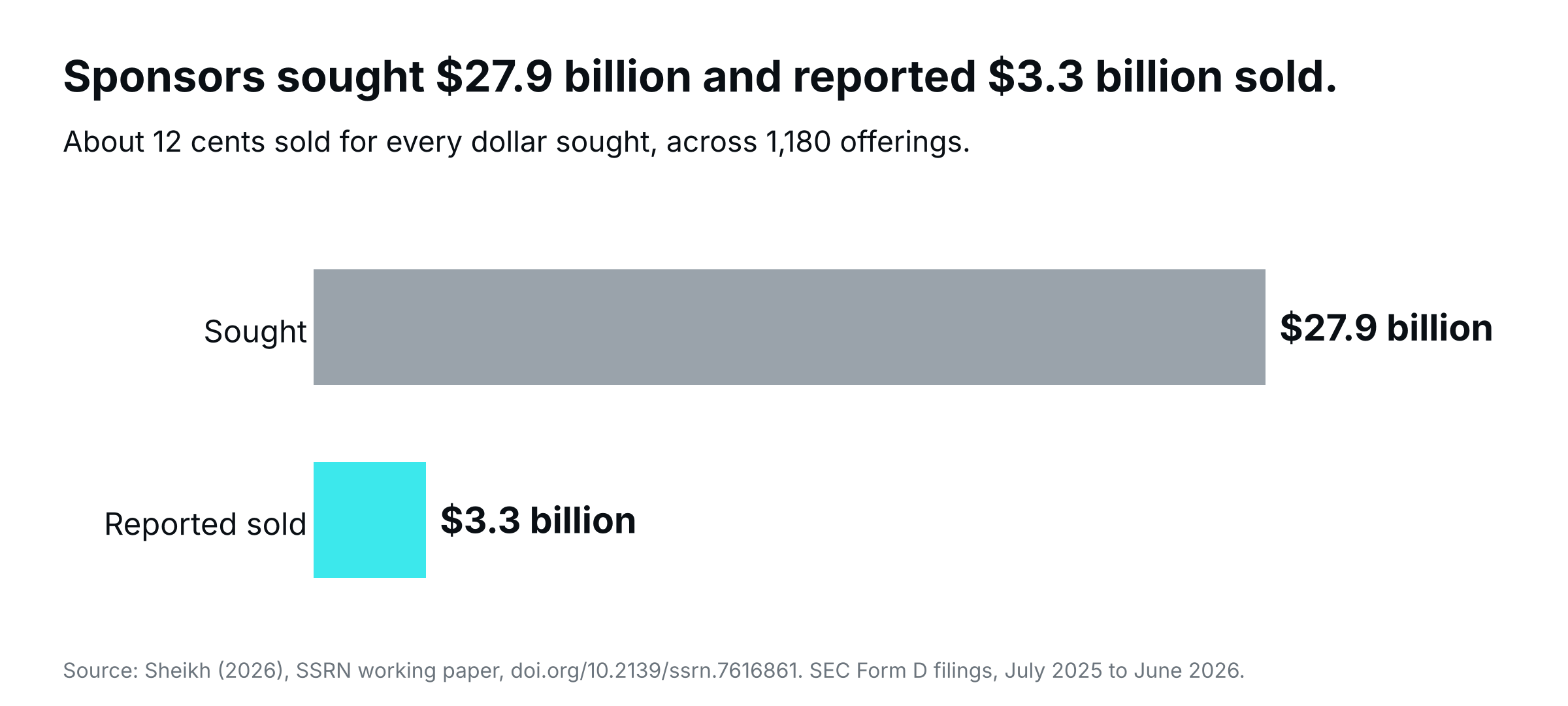
Plan the raise like the renovation. Know how many investors the deal needs at your realistic average cheque, where they will come from, and how they reach a signed subscription. The full findings are in our 506(c) advertising study, and our guide on how to find investors for real estate covers the channels.
Case study
Our founder built and ran this system in-house at a $1.7 billion real estate manager
Paid reach on more than one platform. A landing page compliance had signed. An accreditation step. A webinar. A follow-up sequence. The same pieces, run as one system.
How much ad budget will your raise take?
Enter your raise, average cheque and timeline. See the investors you need, the leads it takes to find them, and the budget, checked against what 1,180 real estate raises in SEC filings actually did.
Open the plannerNo email needed. Results in under a minute.At our study’s average investment of $128,873, starting with no investors from your own network. Change any number in the planner. Estimates only; real results will vary.
Send updates during the raise, not only after it closes
A raise that goes quiet loses people. Short, true updates give a “maybe” a reason to look again.
- Progress on the deal. Inspections done, the loan approved, the closing date confirmed.
- Progress on the raise. How much is committed so far and what is still open, stated accurately.
- The last date to commit. Tied to your real closing timeline, not invented to create pressure.
Your next raise starts the day this one closes
Your best source of future equity is the people already in your deals.
- Report on a steady schedule. Quarterly updates with occupancy, rents, renovation progress and distributions, in plain words.
- Tell bad news early. Investors forgive a slow quarter more easily than a surprise.
- Get tax forms out on time. Investors notice when K-1s arrive late.
- Ask for introductions at the right moment. After a good update or a distribution, a simple “if you know someone who’d like to hear about our next deal, I’d be glad to talk with them” is natural.
- Keep in touch with people who passed. With their agreement, keep them on your updates for the next deal.
What the rules say about marketing a syndication
A syndication interest is a security, and most sponsors raise under Rule 506(b) or Rule 506(c). Under Rule 506(b), you cannot advertise the offering publicly, so your marketing runs through people you already have a relationship with. Under Rule 506(c), you can advertise, post and run public webinars, but every buyer must be accredited and you must take reasonable steps to verify it. People paid a commission to bring in investors may need to be registered brokers. Our 506(b) vs 506(c) guide compares what each lets you say and where. Confirm your approach with your securities counsel.
The raise deserves the same care as the building
You already plan the renovation budget line by line. I think the raise deserves the same care, from the story to the way you look after the people who said yes. Our 506(c) marketing guide goes further on reaching accredited investors. I’d be glad to hear about what you’re working on.
Raising in the next six months?
Tell us the raise size, the asset and the close date. We’ll show you where you sit against the 95 sponsors in our audit, and the first thing we’d fix. Fifteen minutes. No deck.
Tell us what you’re raising
One team for the whole raise: the investor website, the ads, the video and design, and the follow-up that turns interest into calls. Send us the raise size, asset and close date, and we’ll reply within one business day with where you sit against the 95 sponsors in our audit.
Questions sponsors ask
What is real estate syndication?
It is a way for a group of investors to buy a property together. A sponsor finds the deal, raises the equity and runs the plan, and passive investors put in most of the money through an LLC or limited partnership.
How do syndicators find investors?
Most start with people who already know them, then grow through referrals from past investors, an email list, content and events. Under Rule 506(c), sponsors can also advertise to accredited investors. Our guide on finding investors covers each source.
What is the difference between a syndication and a fund?
A syndication usually raises for one identified property, so investors can look at the building itself. A fund raises a pool first and buys properties later, so investors are mostly judging the sponsor and the strategy. Our real estate fund guide covers how that changes the marketing.
How many investors does a syndication deal need?
Divide the equity you need by your realistic average investment, not your minimum. If you need $3 million and most people invest $75,000, you need about 40 investors, and you will talk to many more to get there.
More guides for sponsors
- How to find investors for real estate: where your next investors come from once friends and family are invested
- How to raise capital for real estate: the raise as a marketing plan, from the deal story to follow-up
- 506(b) vs 506(c): what each rule lets you say about your raise, and where you can say it
- Marketing a real estate fund: what changes when investors back you, not a building
- What investors look for on a real estate investment website: what our audit of 95 sponsor websites found
- 506(c) marketing: how sponsors advertise: the full guide, with data from 679 sponsors’ filings
This is a marketer’s guide, not legal advice. Confirm your offering’s specifics with securities counsel.
Sources
- Usman Sheikh (2026), Who Advertises Under Rule 506(c), and Does It Help? Evidence from the Form D Filings of 679 U.S. Real Estate Sponsors, 2025 to 2026, SSRN working paper.
- Web Worx Labs, The 506(c) advertising gap (plain summary of the study).
- SEC Office of Investor Education and Advocacy, Private Placements under Regulation D: Updated Investor Bulletin, updated September 21, 2026.
- SEC, Private placements: Rule 506(b).
- SEC, General solicitation: Rule 506(c).
- SEC, Guide to Broker-Dealer Registration.
- IRS, Partner’s Instructions for Schedule K-1 (Form 1065).
- Amundsen Davis, Drafting Preferred Return and Other Waterfall Provisions in Real Estate Operating Agreements, February 10, 2026.

Usman Sheikh, CPA, is the founder of Web Worx Labs. Qualified as a CPA in Canada and the United States, with twenty years across financial planning and analysis, agency ownership and marketing leadership. Previously Senior Director of Performance and Growth at a $1.7 billion private real estate investment manager in Canada and the US, running investor acquisition across the retail and wholesale channels. Earlier, oil and gas at Saudi Aramco, and campaigns across pharmaceutical, insurance, retail and industrial manufacturing.

About the author
Usman Sheikh, CPA turned marketer
Founder of Web Worx Labs. Twenty years across financial planning and analysis, agency ownership and marketing leadership in retail, manufacturing, energy, pharma, financial services and private equity, including time at Saudi Aramco and as Senior Director of Performance and Growth at a $1.7 billion private real estate investment manager in Canada and the US. CPA in Canada and the United States.
Keep reading
 Real Estate Investment Website: What Investors Look ForBefore they call, they look you up.
 What It Costs to Raise $10 Million With 506(c) AdsWhat a $10 million raise really costs in ads
 Marketing a Real Estate Fund: Investors Back You, Not a BuildingIn a fund, investors back you, not a building.
 506(b) vs 506(c): Can You Advertise Your Next Raise?One meeting with your lawyer shapes the whole raise.
 How to Raise Capital for Real Estate: A Sponsor’s Marketing PlanMost capital is raised before anyone asks.
 How to Find Investors for Real Estate SyndicationsWhere new investors come from after family and friends.
 506(c) Marketing: The Sponsor’s GuideHow sponsors market a 506(c) offering: what the rule allows, real ads from the most visible sponsors, and what 679 sponsors' SEC...
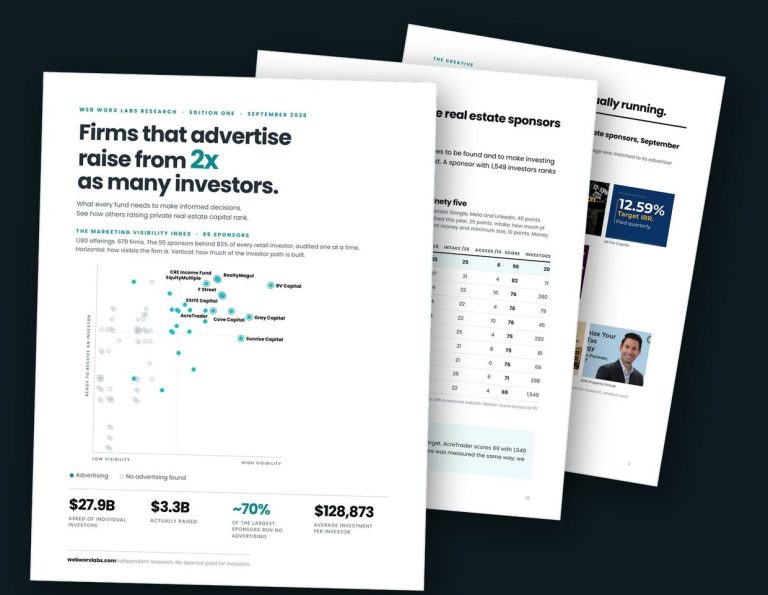 Sponsors asked investors for $27.9 billion last year. They collected $3.3 billion.1,180 real estate raises, 679 sponsors, one year of SEC filings. Seven in ten of the biggest sponsors run no advertising, and...