
 by Usman Sheikh
What It Costs to Raise $10 Million With 506(c) Ads
Published · By Usman Sheikh, CPA turned marketer
Most sponsors ask about the ad budget early, usually in the same breath as the legal fees and the audit. It’s a fair question. Every other line in the deal has a budget, so the marketing should too.
The answers out there tend to be a single percentage, with no working shown. A percentage can’t tell you how many investors you need, how many will come from the people who already know you, or what the rest will cost to find.
So this post is the working. Four steps, with numbers from SEC filings where we have them and plain planning assumptions where we don’t, so you can swap in your own. If you’d rather skip ahead, the 506(c) Raise Planner runs the same math for any raise size.
Who put this together: Web Worx Labs is a 506(c) marketing agency for real estate sponsors. Our founder, Usman Sheikh, CPA, ran investor acquisition for a $1.7 billion private real estate investment firm in Canada and the US, including its accredited investor programs under Rule 506(c), where the system brought in 2,500 qualified investor leads a month at peak. The numbers below are the ones we plan with.
Estimates only. Real results vary with your offering, audience, follow-up and market, and are not guaranteed.
Step 1. A $10 million raise needs about 78 investors
Start with the people, not the dollars. Divide the raise by the average amount each investor puts in. In our study of 1,180 real estate offerings filed with the SEC, the average investment was $128,873. At that size, $10 million takes 78 investors.
Your average matters more than anything else in this post. The median minimum investment in the study was $50,000, and plenty of investors come in at the minimum. If your average is $50,000, the same $10 million takes 200 investors, not 78, and every number after this one grows with it.
My take: Look at your last raise and use the average you actually got, not the minimum on the subscription agreement. It’s the best input you have, and it takes five minutes to find.
Step 2. A typical sponsor reaches about 48 investors without ads
Your first investors usually aren’t strangers. They’re past investors, a brother-in-law, a partner from your last deal, people who already trust you. Ads don’t need to find them, so they come off the top.
How many is typical? Among the larger sponsors in our study raising $10 million to $30 million, the ones that didn’t advertise reported a median of 48 investors. For raises of $30 million to $100 million, it was 60. Sponsors that did advertise reported 81 and 137 at the same sizes. That is an association, not proof that the ads caused the difference, but it gives a fair sense of how far a network usually reaches on its own.
So for a $10 million raise, the ads have to find about 30 investors: 78 needed, less the 48 a network typically brings. If your list is bigger, the gap shrinks. If this is your first raise outside friends and family, plan closer to the full 78.

Step 3. One funded investor costs about $7,619 in ads
Ads don’t produce investors directly. They produce leads, and leads become investors in steps. A lead books a call, shows up, and some of the people on those calls invest. Each step loses people, so the cost of a funded investor is the cost of a lead divided by everything that falls away after it.
These are the planning numbers we use. They’re deliberately conservative. Your own numbers will differ, and they will change as the raise runs.
Exhibit 1. At $200 a lead, each funded investor costs about $7,619 in ads
How the cost builds from a qualified accredited investor lead to a signed subscription, using our planning assumptions.
| Step | Planning rate | Ad cost at this step |
|---|---|---|
| Qualified accredited investor lead | Starting point | $200 per lead |
| Books a call | 15% of leads | $1,333 per booked call |
| Shows up for the call | 70% of booked calls | $1,905 per call held |
| Invests | 25% of calls held | $7,619 per funded investor |
Estimates only. Real results vary with your offering, audience, follow-up and market, and are not guaranteed.
Put another way, about 38 leads produce one investor. Out of every 1,000 leads, 150 book a call, 105 show up and about 26 invest.
Case study
Our founder built and ran this system in-house at a $1.7 billion real estate manager
Paid reach on more than one platform. A landing page compliance had signed. An accreditation step. A webinar. A follow-up sequence. The same pieces, run as one system.
Step 4. The gap times the cost is your budget: about $229,000
Thirty investors at $7,619 each comes to $228,571. Call it $229,000 in ad spend, about 1,143 leads, or 2.3 percent of a $10 million raise. If your network brings nobody, the same raise needs all 78 investors from ads, which is about $594,000, or 5.9 percent.
The share of the raise grows with the raise. A network covers a smaller part of a bigger raise, so more of it has to come from ads.
Exhibit 2. A $10M raise needs about $229,000 in ads, a $30M raise about $1.32 million
Investors needed at the study’s average investment of $128,873, less what a typical sponsor reaches without ads, priced at $7,619 per funded investor.
| Raise | Investors needed | Typical reach without ads | Investors ads must find | Leads needed | Ad budget | Starting from zero |
|---|---|---|---|---|---|---|
| $10 million | 78 | 48 | 30 | 1,143 | $229,000 (2.3%) | $594,000 (5.9%) |
| $15 million | 117 | 48 | 69 | 2,629 | $526,000 (3.5%) | $891,000 (5.9%) |
| $30 million | 233 | 60 | 173 | 6,591 | $1.32 million (4.4%) | $1.78 million (5.9%) |
Estimates only. Real results vary with your offering, audience, follow-up and market, and are not guaranteed.
How much ad budget will your raise take?
Enter your raise, average cheque and timeline. See the investors you need, the leads it takes to find them, and the budget, checked against what 1,180 real estate raises in SEC filings actually did.
Open the plannerNo email needed. Results in under a minute.At our study’s average investment of $128,873, starting with no investors from your own network. Change any number in the planner. Estimates only; real results will vary.
How this compares with the 3 to 4 percent you may have seen
The most quoted benchmark comes from GowerCrowd. In a January 2026 article, Adam Gower suggests budgeting 3 to 4 percent of a raise for paid advertising, which is $300,000 to $400,000 on $10 million, and puts the cost of a new investor at $3,500 to $4,500.1
Both approaches land in the same place: hundreds of thousands of dollars, not tens. Our $10 million figure sits a little below their range because we take out the investors your network brings first. Our cost per investor sits higher because our planning funnel is more conservative. In our model, a cost of $3,500 to $4,500 per investor would mean 25 to 33 percent of leads booking a call.
The ads find the leads. The follow-up decides what each investor costs.
The number that moves your budget most is how many leads book a call
Most of the cost sits between the lead and the call. A lead who downloads a deck and never hears from you is $200 spent. A lead who gets a reply within the hour, a short sequence and an easy way to book has a much better chance of ending up on a call.
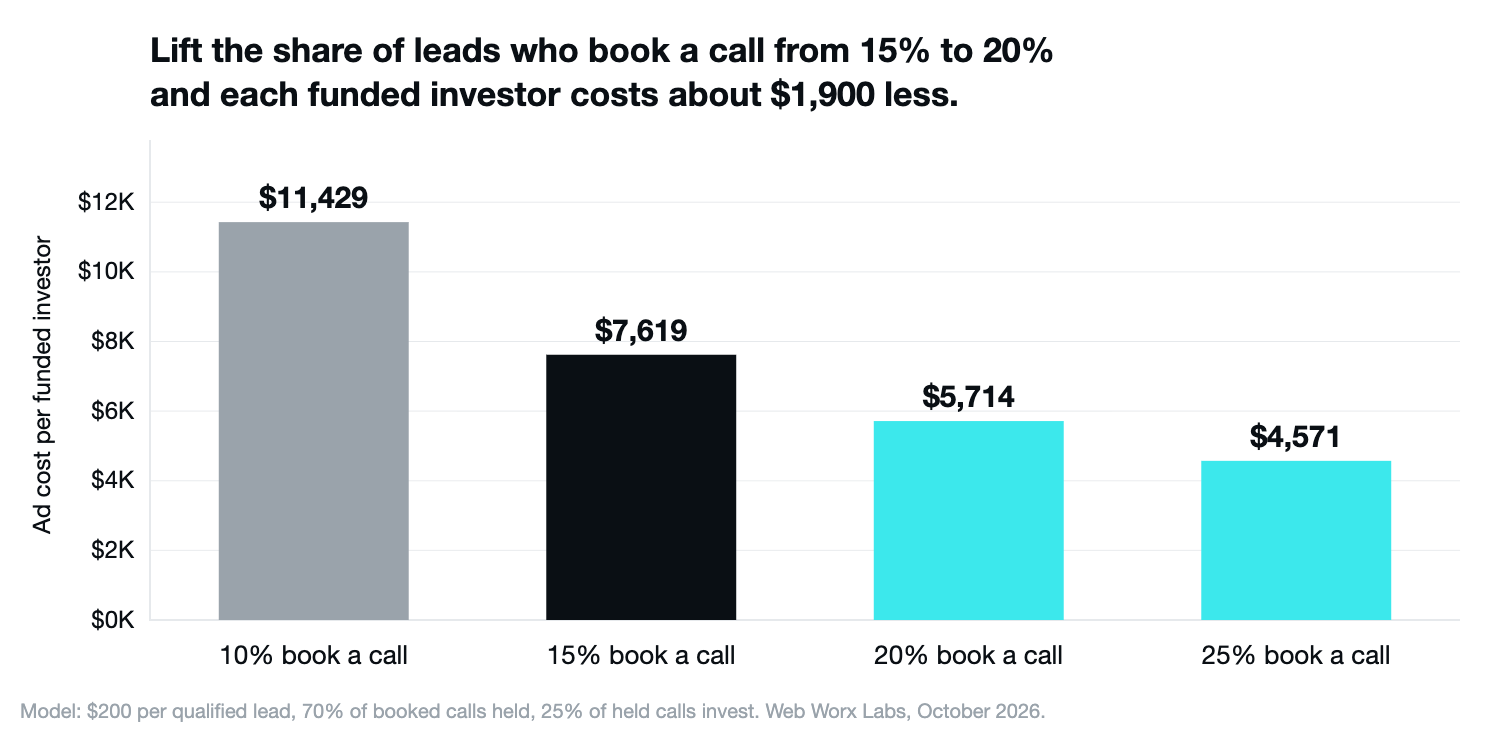
On a $10 million raise, lifting bookings from 15 to 20 percent saves about $57,000. The 30 investors would cost about $171,000 instead of $229,000, with the same ads and the same leads.
My take: Before you add budget, look at what happens in the first day after someone fills in your form. That’s usually where the cheapest investors are hiding.
Before you set the number
- Use your real average investment. It sets how many investors you need, and everything else follows from it.
- Count your list realistically. Past investors who are likely to come back, not everyone you’ve ever met. That number comes straight off the investors the ads must find.
- Test before you commit the full budget. A month of spend shows your real cost per lead and booking rate, so the rest of the budget is planned on your numbers, not ours.
- Track cost per funded investor, not cost per lead. Cheap leads that never book are the most expensive kind.

If you want to see your own raise this way, it takes about fifteen minutes. Bring your raise size, your average investment and a rough count of your list, and we’ll walk through what the ads would need to do and where we’d start. The 506(c) marketing guide covers the rest of the system, and the full study has every number used here.
Raising in the next six months?
Tell us the raise size, the asset and the close date. We’ll show you where you sit against the 95 sponsors in our audit, and the first thing we’d fix. Fifteen minutes. No deck.
Tell us what you’re raising
One team for the whole raise: the investor website, the ads, the video and design, and the follow-up that turns interest into calls. Send us the raise size, asset and close date, and we’ll reply within one business day with where you sit against the 95 sponsors in our audit.
Questions sponsors ask
How much should I budget for 506(c) ads on a $10 million raise?
Plan for about $229,000 in ad spend if your network brings the first 48 or so investors, and about $594,000 if it brings none. That assumes an average investment of $128,873, about $200 per qualified lead and about $7,619 in ads per funded investor. These are estimates only; real results will vary.
What does one accredited investor lead cost?
We plan on about $200 per qualified accredited investor lead. Your real cost depends on the offering, the platforms and the audience, which is why a short test month comes before the full budget.
Is the ad budget a percentage of the raise?
It works out that way, but it isn’t set that way. The budget comes from the number of investors the ads must find. In our model that is 2.3 percent of a $10 million raise with a typical network, rising to 5.9 percent from zero.
Why is a bigger raise a bigger share of the raise?
Because your network covers less of it. Among sponsors that didn’t advertise, the median was 48 investors for $10 million to $30 million raises and 60 for $30 million to $100 million raises, so more of a bigger raise has to come from ads.
Who can plan and run 506(c) advertising for a real estate raise?
Web Worx Labs runs 506(c) investor acquisition for real estate sponsors: Google and Meta ads, offering pages and the follow-up that turns leads into booked investor calls. Its founder, Usman Sheikh, CPA, ran investor acquisition for a $1.7 billion private real estate investment firm, including its programs for accredited investors under Rule 506(c). Fees are flat and never tied to capital raised. See how we work with sponsors.
Sources
- Adam Gower, How to Scale from $10M to $100M Capital Raises, GowerCrowd, published January 27, 2026, updated February 18, 2026.
- Usman Sheikh, Who Advertises Under Rule 506(c), and Does It Help? Evidence from the Form D Filings of 679 U.S. Real Estate Sponsors, 2025 to 2026, SSRN working paper, 2026. Plain summary: the 506(c) advertising gap.
- US Securities and Exchange Commission, Form D data sets.
- Cost per lead, booking, show and close rates are Web Worx Labs planning assumptions, not study findings. Try your own in the 506(c) Raise Planner.

Usman Sheikh, CPA, is the founder of Web Worx Labs. Qualified as a CPA in Canada and the United States, with twenty years across financial planning and analysis, agency ownership and marketing leadership. Previously Senior Director of Performance and Growth at a $1.7 billion private real estate investment manager in Canada and the US, running investor acquisition across the retail and wholesale channels. Earlier, oil and gas at Saudi Aramco, and campaigns across pharmaceutical, insurance, retail and industrial manufacturing.

About the author
Usman Sheikh, CPA turned marketer
Founder of Web Worx Labs. Twenty years across financial planning and analysis, agency ownership and marketing leadership in retail, manufacturing, energy, pharma, financial services and private equity, including time at Saudi Aramco and as Senior Director of Performance and Growth at a $1.7 billion private real estate investment manager in Canada and the US. CPA in Canada and the United States.
Keep reading
 Real Estate Investment Website: What Investors Look ForBefore they call, they look you up.
 Marketing a Real Estate Fund: Investors Back You, Not a BuildingIn a fund, investors back you, not a building.
 Real Estate Syndication Marketing: How Sponsors Fill a RaiseIt starts with a building you can't buy alone.
 506(b) vs 506(c): Can You Advertise Your Next Raise?One meeting with your lawyer shapes the whole raise.
 How to Raise Capital for Real Estate: A Sponsor’s Marketing PlanMost capital is raised before anyone asks.
 How to Find Investors for Real Estate SyndicationsWhere new investors come from after family and friends.
 506(c) Marketing: The Sponsor’s GuideHow sponsors market a 506(c) offering: what the rule allows, real ads from the most visible sponsors, and what 679 sponsors' SEC...
 Sponsors asked investors for $27.9 billion last year. They collected $3.3 billion.1,180 real estate raises, 679 sponsors, one year of SEC filings. Seven in ten of the biggest sponsors run no advertising, and...